The Senses Considered As Perceptual Systems Gibson Pdf Download
The standalone version is unlimited, the VST has 3 stereo outputs. There are 32 Bit and 64 Bit versions. Minihost modular beta 3 integrin. - Multi-input/multi-out (MIDI & audio) support. Features include: - Works as standalone and VST or AU host on Windows and macOS.
- The Senses Considered As Perceptual Systems Gibson Pdf Download Pdf
- The Senses Considered As Perceptual Systems Gibson Pdf Download Free
- The Senses Considered As Perceptual Systems Gibson Pdf Download Pc
- The Senses Considered As Perceptual Systems Gibson Pdf Downloads
Because each sensory modality may be considered as a separate information channel. Possessions and the extended self. The senses considered as perceptual systems. The senses considered as perceptual systems. The Senses Considered as Perceptual Systems James J. Gibson Snippet view - 1966. The senses considered as perceptual. THE SENSES CONSIDERED AS PERCEPTUAL SYSTEMS These five perceptual systems overlap one another; they are not mutually exclusive. They often focus on the same information - that is, the same information can be picked up by a combination of perceptual systems working together as well as by one perceptual system working alone.
M •••••Snip ii-7-81 english pdf download free apps. The theory to be outlined is partly developed in The Senses Considered as Percep-tual Systems(Gibson, 1966), especially in chapters 9–12 on vision. It is related to. Of The Senses Considered as Perceptual Systems. The classical doctrine that pro. A Theory of Direct Visual Perception 79. Perceptual constancy is the ability of perceptual systems to recognize the same object from widely varying sensory inputs.:118–120 For example, individual people. Multisensory perceptual learning reshapes both fast and slow mechanisms of crossmodal processing. Adaptive behavior requires that signals from different senses be integrated. To ask other readers questions about The Senses Considered as Perceptual Systems, please sign up. Be the first to ask a question about The Senses Considered as Perceptual Systems The cooperation of supposedly separate senses of touch and kinesthesis is an old and controversial problem in psychology.
18t'-
'20
V
'1M
1 Ms
<>
't
K Ial'l'& 1 bl.,'
'1
19
~I'
' K
17
.
'
:=: ~~,
81-1 ED
V,U.~N
Y'I ~
':I
ZeQ
~
Y Z.
~
H '•. h:
H
..
I,J
L,j
@
K
K
Kl
K
k
.J
L-
Ld 1 L
1
MI'
~
N
k~
o OU.,~Ir..., 2- 0 o o''&~ g rn pei. f rn
'1
.,
L
~/!
Nl/M Me ••• ,m
N
M
'
N en ~
N
n.
m 0
ao
00
2
0
0
n
rp
P
f
P
P
9 q
QQ.
Q''~
Q
q
pp
R
R
r
~S
Ses
!
5
S
1'
l'T
T h.
~
T
t
pe
M
0 !:
!
S~
T
~
T
T
V u. ';!-,'!! V,U~
1.-/
~!sir&
~
E e F f
I
pp
+x
8H
D d
I
p
'22-
e
Aa.
I )!
I
<1q
~t,.
••
9,e
D
~ ~ ~ 1
16
c:.
0
U.ab.
1~
(C
~
e
N
1
The Senses Considered As Perceptual Systems Gibson Pdf Download Pdf
E,I
E9
',.,
b
C
AD
t
/7 =F
14
B
~
!i
Ih.
'v
B I.e. !
c c.e
t>D
H
h
~8
d.
T •.•. , •.•. ~lcot •.•.
Z
a
4ell:.
1W'
7
/>.A All. ~
$~-
A E •••.• QP.J_
Y
11.
r
A
~ AA ~ 8 ~ i(
rIO
t& ••.
..,
er !:
Figure 11.6 Early alphabets. This table represents the descent of the western alphabet, the Roman, from the Semitic. (Reprinted from The Triumph of the Alphabet: A History of Writing, by A. C. Moorhouse. By permission of Abelard-Schuman, Ltd. All rights reserved. Copyright 1953 by Henry Schuman, Inc.)
at its best, cannot generalize as literature can - not in the same ways. Consider the structure of light reflected from a series of adjacent letters. They can be written on stone, clay, papyrus, vellum, or paper, and can be made by stylus, brush, charcoal, pen, or typeface. This structure
244 /
THE SENSES CONSIDERED AS PERCEPTUAL SYSTEMS
carries information, as does the structure of light reflected from naturally pigmented or contoured surfaces, but the information is of much higher order. The invariants in the light from a human' face specify the man. The invariants in the light from a picture of the face can specify the man. The invariants in the sound of his name specify the man, and thus the invariants of the letters that spell his name specify him. And finally the long string of printed letters that can say 'this man is wanted for murder' specifies the man in the whole context of his group. There are different orders or levels of information in these examples of stimulation. The man and his picture provide direct stimulus information about him. The letters of his name, and the printed message, provide what may be called coded stimulus information about him, that is, information mediated by the language and the spelling system. At all four visual levels, (1) seeing the man, (2) seeing his picture, (3) reading his name, and (4) reading about him, the information has to be carried by structured light. There has to be an array with borders, textures, patterns, or forms, and this is why the problem of defining the structure of an array is so fundamental.
The Difference between Perceptual Meaning and Verbal Meaning In a book called The Meaning of Meaning, Ogden and Richards (1930) suggested that meaning consisted of a three-way relation between a thought, a symbol, and its referent. But this is surely not the only meaning of meaning. I have suggested in this book that a three-way relation exists between a percept, a stimulus invariant, and its source. The relations between the terms in the latter case are very different from those in the former. The meaning of a stimulus invariant is therefore different from the meaning of a symbol, such as a word. A stimulus invariant is related to its source in the world by laws of ecological physics, whereas a word is related to its referent by social convention. A percept is related to a stimulus invariant by the resonance of a perceptual system (as I shall argue), where a thought is related to a word by the learning of an association. The differences are diagrammed below:
Perceptual meaning
Verbal meaning
Environmental source
1--------1
Physical law
Social Convention
L- __
----J
Psychological resonance
Psychological association
THE STRUCTURING OF LIGHT BY ARTIFICE /
Two Conceptions of the Information
245
in Stimulation
Perhaps it is now possible to understand more clearly two different conceptions of stimulus information, both of which are valid but only one of which has been emphasized so far in this book. One is information about. The other is information considered as structure. The former permits perception of. The latter allows perception considered as discrimination. In the last ten or twenty years there has arisen a mathematical tool, called 'information theory,' which has many applications in psychology (Attneave, 1959) and other disciplines. It suggests methods of describing the stimuli for psychological experiments in quantitative terms. A stimulus may be treated simply as 'what it is not but might have been,' and information is defined as the reduction of uncertainty. This can be measured. A letter of the alphabet, for example, is differentiated by not being any of the other 25, and that, you might say, is all there is to a letter. Note that the meaning of a stimulus (what it stands for, or the source of a stimulus) is excluded from consideration. With this approach, the psychologist can provide stimuli for perception or learning in pure form, without having to worry about the puzzle of epistemology. Garner has recently written about Uncertainty and Structure as Psychological Concepts (1962), suggesting that the structure of visual or auditory stimulation is the basis of what others have called information. One has to agree that spatial and temporal structure are requisites for perception since otherwise there is nothing to be discriminated. But this is information only as it provides the opportunity to distinguish, not the opportunity to perceive. The psychologist's concern with optical structure as such is comparable in some ways to the artist's. The mere distinguishing of its limitless variations is interesting. The psychologist wants to test the limits of the capacity to distinguish; the artist wants to know the distinguishable variables of display. The case is similar for the musician concerned with the structure of instrumental sounds. Whether or not pure art and pure music have 'meaning' is another question; at least they have structure. The structure of light and sound, the higher-order variables of simultaneous and successive order, constitute information in a special sense of the term, and a legitimate one. But this modem sense of the term is not the original one. According to the dictionary, information is 'that which is got by word or picture,' and nothing is said about structure. Let us review the proposals made so far. Stimulus energy, unless it has structure, conveys no information. The natural structure of stimulation from the near environment conveys information directly. The structure of stimulation from representations conveys similar information, but
246 /
THE SENSES CONSIDERED AS PERCEPTUAL SYSTEMS
indirectly. The structure of stimulation from socially coded or conventional signals conveys information still more indirectly. All these are information about the environment, although an increasingly remote environment. Finally the structure of stimulation from the displays of artists and experimenters on perception, from 'abstract' art and the various devices for stimulating human eyes by artifice, conveys information in a pure mathematical sense. I have called it information as such.
Equivocal
Information
from
a Picture
There is a class of pictorial displays that has long interested both psychologists and artists, in which alternative perceptions may be evoked by the same display. It is as if there were two things represented in the same place. The examples from experimental psychology are called the reversible figure-ground illusion and the reversible perspective illusion (Figure 11.7). In the former, a border or margin representing the edge of one surface superposed on another is arranged so that the apparent depth at the edge can reverse direction, the object becoming background and the background object. A goblet becomes a pair of faces, or vice versa. In the latter, a line representing the dihedral angle of two or more surfaces, the junction or 'corner,' is arranged so that the apparent convexity or concavity can reverse, and what formerly protruded is now hollow or vice versa. The back of a book becomes the front of a book, as shown, or a whole staircase from above becomes a staircase from below. The reversibility of ridges and valleys was illustrated in Figure 10.11, and this is also a case of ambiguous convexity-concavity. There can be ambiguity in a frozen representation of a layout of surfaces. The absence of perspective transformations to specify the directions of slant is characteristic of such a picture. The ambiguity may even appear in different parts of the same apparent object as illustrated in Figure 11.8. The phenomenal object or surface layout is then 'impossible.' The fact that alternative perceptions can arise from the same optic array is very puzzling. The stimulus has two different effects. This would seem to refute the assumption stated above (p. 228), that the same stimulus coming to the eye will always afford the same experience. The structure of the light has not changed when a pair of faces is seen instead of a vase, but the percept has changed. Doesn't this fact disprove the supposed dependence of perception on stimulation and prove instead that it also depends on the observer? The reversibility of perception with a constant stimulus has been so interpreted. It has even been taken to mean that there is no hope of discovering a lawful correspondence
THE STRUCTURING OF LIGHT BY ARTIFICE
/
247
Figure 11.7 Reversible surface-or-air and reversible convexity-or-concavity. On the left are two examples of ambiguous
figure and ground (the goblet-faces display and the alternative Maltese crosses). On the right are two examples of reversible 'perspective' (the ambiguous book and the ambiguous staircase). Stare at the center of each drawing for a time; observe what happens. between stimulation and perception (Gibson, 1959). But let us examine the facts more closely. In the goblet-faces display, the stimulus is the same for the two percepts but the stimulus information is not. In the absence of texture and parallax, the information for edge-depth or superposition has been arranged to specify two opposite directions of depth. There are two counterbalanced values of stimulus information in the same 'stimulus.' The perception is equivocal because what comes to the eye is equivocal. In such displays, the information for one-thing-in-front-of-another must
248 /
THE SENSES CONSIDERED AS PERCEPTUAL SYSTEMS
/
/
/
V Figure 11.8 Impossible surface layouts in outline drawings. When lines are used in a drawing, as distinguished from pigments in a painting, they can be ambiguous in their representation of surfaces. Contradictory values of the information for layout may be counterbalanced, as in these two examples.
come from variables of the mutual contour at the optical junction of the two things. The complexity of such variables is illustrated in Figure 11.9, where superposition may go one way, or the other way, or neither. In the displays of reversible convexity-concavity and of paradoxical transitions between substance and space, the same suggestion can be offered, that contradictory counterbalanced information about surface layout may coexist in the same picture. We are accustomed to the idea of 'conflicting cues' from different senses, but the idea of conflicting information from the same sense is unfamiliar. There is nothing implausible about it, however, once we grant that sensations of light and dark are irrelevant to the problem. The hypothesis of stimulus information can now be restated more generally. The same stimulus array coming to the eye will always afford
the same perceptual experience insofar as it carries the same variables of structural information. If it also carries different or contradictory variables of information it will afford different or contradictory perceptual experiences. The puzzle of two or more reactions seemingly caused by the same
CD OJ OJ CD Figure 11.9
What makes one disk appear in front of the other?
THE STRUCTURING OF LIGHT BY ARTIFICE
/
249
'stimulus' arises, of course, for overt behavior as well as for perceptual activity. It has long been a difficulty for the stimulus-response hypothesis. 6
Long ago it was found that the display of 4 to a human subject would sometimes evoke the response '10' and sometimes the response '2'. The puzzle was resolved by assuming that the response was a function of the subject's 'set,' the aufgabe or 'determining tendency,' as well as a function of the stimulus (Gibson, 1941). The response to the display depended on a task set to add or to subtract. But note that the display is ambiguous, unlike that of 6 + 4 or 6 - 4. The apprehension of the task itself depends on stimulus information; in the absence of information it is got by 'context,' or by whatever information there may be in the 'total situation.' The paradox of different responses to the same 'stimulus,' then, can be resolved by analyzing the stimulus for the information it contains as well as by appealing to subjective determining tendencies. And these latter will generally turn out to be forms of attention. A discussion of abstractive attention, and of the education of attention, will be offered in Chapter 13.
~{JJ
the Pickup of Ambient Information: Stanning
The perceptual systems are capable of obtaining external stimulation, not merely of having it imposed on their receptors. This was the theme of Chapter 2. The principle has been exemplified in succeeding chapters. The auditory system can obtain equal stimulation at the two ears. Smelling and tasting obtain chemical stimulation at the receptors. The haptic system obtains tactile stimulation by exploratory movements of the hands. Above all, the human visual system obtains new samples of the array of ambient light by the activity called scanning. Scanning is defined as looking at parts of an array in succession. The obtaining of successive incoming cones of light, be it noted, is analogous to the obtaining of successive touches from a surface layout. Samples of external stimulation are obtained for the sake of the information they carry about the environment, not for the sensations that may (or may not) accompany them. As a general rule, the individual explores, samples, or scans the sea of energy around him for what this proximal stimulation will specify about its ultimate sources. There are special cases, of course; the human individual can visually scan a picture for its design, but what he is generally in search of is meaning. The esthete may practice discrimination and enjoy the structure of a painting or the composition of music, but this is a sort of perceptual luxury. In order to search, an active perceptual system has to be propriosensitive as well as exterosensitive, that is, it has to be self-guided in order to home in on the external information. This is true of looking, touching, smelling, tasting, and even listening. How the input of information is separated from the feedback of the system itself, or how it differs from the feedback, is not yet clear. An examination of the temporal course of perception in scanning may help to explain how this isolation or extraction occurs. The last two chapters have been concerned with the available inforrna250
THE PICKUP OF AMBIENT INFORMATION:
SCANNING /
251
tion for vision. Here we consider the actual pickup process. In man, visual attention is a matter of looking. Exploratory looking is somewhat like exploratory feeling as the process was described in Chapter 7. Each perceptual system has its own peculiar mode of attention, but these two are especially capable of sampling in discrete acts. Active smelling and tasting are less clearly episodic, and listening is the least capable of selective sampling.
The Problem
of Perceiving
by Scanning
The man in the dark who gropes with his fingers, like the insect who gropes with his antennae, seems to get a succession of contact stimuli, not a simultaneous pattern of them. Nevertheless, it is surely the simultaneous layout of the surfaces that he detects, whether or not he experiences a succession of sensory impressions. Similarly, a man who looks around the world, like any animal whose eyes are in the front of his head, seems to get a succession of optical stimuli, not a simultaneous panorama. What he ordinarily perceives, however, is the visual world, not a succession of visual fields. The perception of a constant object that is explored by touching and the awareness of a constant environment that is explored by looking present a difficulty. It is especially a difficulty for the theory of sensationbased perception. How can a series of touch sensations be converted into the impression of a single thing? How can the sequence of retinal sensations be converted into the apprehension of a scene? The only solution to this difficulty seemed to be an appeal to memory. More exactly, the brain must be supposed to construct a simultaneous composite from the sequence of sensory data. This requires that each sensory datum be held over, or temporarily stored, in the form of a trace, so that the series can be put together at one time. Problems then arise as to how all the traces can be stored, at what place in the brain, and once stored, how they can later be retrieved. These problems are as yet unsolved. The theory of information-based perception can avoid these difficulties by denying that sensations combine with their traces to be converted into perception. It need not assume that perception requires a simultaneous composite in the brain - either a process of integrating successive data or one of organizing simultaneous data. The perception of a unitary constant object over time, or of a unitary visual world over time, might be explained by the assumption that unchanging information underlies the changing sequence of obtained stimulation, and that it gets attended to. This new assumption, of course, may seem to present equally serious difficulties, but perhaps they can be overcome.
252 /
THE SENSES CONSIDERED AS PERCEPTUAL SYSTEMS
Apprehension by scanning, or more generally, by sequential sampling, is a problem for vision and touch, but it ramifies into other fields of psychology. Awareness of things in time, and awareness of time, as Boring notes (1942, Ch. 15), has a long and obscure history. The relation of memory to learning puzzled Lashley (1951) - he called it the 'problem of serial order in behavior.' We will consider the problem only in relation to vision and touch but we will recognize its generality. In order to comprehend the problem, let us take it up piecemeal.
The Equivalence of Successive Sampling to Simultaneous Grasping The detection of an adjacent arrangement has been taken to be simpler than the detection of a successive arrangement, on the grounds that the former requires only perceiving whereas the latter requires both perceiving and remembering. But this usage of the two terms is not consistent with the fact that a successive order may be equivalent to an adjacent order. An observer can apprehend a five-place number, say, when it is presented to vision in adjacent order (in the window of a tachistoscope) or when it is presented to audition in successive order (by speech). The same thing is true of a printed word and a spoken word; both are within the span of apprehension. It violates the facts to suppose that adjacent letters are governed exclusively by a span of perception while successive sounds are governed exclusively by a span of memory. Within limits, perception spans both kinds of order, spatial and temporal. This consideration seems to imply that the brain does not have to construct a simultaneous composite in order to register a sequence of items. The impossibility of sharply dividing perception from memory has led to the notion of 'immediate' memory, or 'primary' memory, or 'short-term' memory, but these compromises do not solve the difficulty. Now the remarkable fact about visual scanning is that awareness of the succession of temporary retinal impressions is completely absent from the perceptual experience. There is awareness of the simultaneous existence of all the objects in the world, or all the parts of a picture, despite the fact that the objects, or parts, are fixated one after another - at least with our kind of vision. The whole physical array seems to coexist phenomenally although it has been looked at sequentially. No one has ever been able to count his eye fixations while inspecting the world, or a picture, although it is easy to count the number of objects in the array. The retinal-impression theory of perception has an elaborate explanation of this puzzling fact in terms of a presumed internal cancelling of the retinal motions and an unconscious combining of retinal impressions (Helmholtz, 1925, p. 570). But it might be accounted for as a case of the equivalence of successive sampling and simultaneous grasping.
THE PICKUP OF AMBIENT INFORMATION:
SCANNING /
253
In the evolution of vertebrate vision, it should be remembered, the fish began with panoramic eyes that could encompass most of the ambient array at once. Later, as Walls (1942) suggests, some animals sacrificed the simultaneous grasp of ambient light for the advantages of frontal eyes. But this requires turning the head in order to get a full view of the surroundings. Overlapping, successive part views had to be substituted for the full view, and the nervous system of the animal had to be adapted to this substitution. The brain had to trade space for time, as it were. The equivalence of successive to simultaneous pickup is also demonstrable in tactile scanning with the human observer. The experiment on the identifying of unfamiliar objects by haptic perception, reported in Chapter 7, showed that the shape of a sculptured solid could be detected by simply holding it motionless with the five fingers of one hand (or the ten fingers of two hands). In this method the shape is grasped, figuratively as well as literally, by means of the simultaneous compound input of the skin and joints. But the shape could also be detected as well or better by another method, in which the fingers were allowed to move over the layout of the solid, exploring its convexities and concavities, one by one or in various combinations. The simultaneous input, the momentary pattern from the skin and joints, was then not noticed. Neither was the sequence of the transformed patterns of input. Instead, the invariants of the object's shape emerged clearly from the successive transformations. Evidently, exploratory movement of the fingers can be substituted for a grasping posture of the fingers, and the information about convexities and concavities can still be picked up. Again, the brain seems to be able to trade space for time.
The Stable and Unbounded Character Phenomenal Visual World
of the
The visual world as I once described it (Gibson, 1950, Ch. 8) has the property of being stable and unbounded. By stability is meant the fact that it does not seem to move when one turns his eyes or turns himself around (Figure 12.1) and that it does not seem to tilt when one inclines his head. By unboundedness is meant the fact that it does not seem to have anything like a circular or oval window frame. The phenomenal world seems to stay put, to remain upright, and to surround one completely. This experience is what a theory of perception must explain. The visual field, which seems to be experienced when one concentrates on what it feels like to see, does seem to be displaced when one turns the eye or head, it does rotate when one lies on his side, and it does have a sort of window-like boundary between inner content and outer nothingness, or indeterminacy. The mosaic of retinal receptors is displaced
Figure 12.1 A sequence of visual fields from left to right in the ad of looking around a room. The man is sitting in an easy
chair with his feet up. He is looking around the room. The drawings represent the visual field of the left eye in four stationary postures of the eye. His gaze is horizontal and the center of each field represents his point of fixation. Each is a wide-angle field; the
reader's eye would have to be very close to the picture for it to project the same angular array that was admitted to the man's eye. His nose appears at the right of each field. His body appears at the bottom of the field when he is looking forward. What does the man see? The answer is that he has four successive pictorial sensations but he perceives the room.
256 /
THE SENSES CONSIDERED AS PERCEPTUAL SYSTEMS
correspondingly relative to the retinal image and is rotated relative to the retinal image, and the mosaic has an anatomical boundary. Note that it is the retina that moves relative to the image projected on it, not the other way around, as we have been taught. The retina moves relative to its image and relative to the pattern occupied by excited receptors. The doctrine of the 'transposability' of the retinal image is therefore stated backwards; usually it is the retina that is transposable over its relational pattern of excitation - a pattern that is projected from the outer world (Cf. Gibson, 1950, pp. 55ff.). The sensation of the unstable and bounded visual field, I now suggest, comes from a vague kind of detection of the retinal mosaic. It is a matter of sensing the retina as such, not the image and not the relational pattern occupied by excited cells. Only insofar as one detects the qualities of the neurons, as required by the doctrine of Johannes Muller, does one have a sensation of a moving window. Insofar as the brain detects the relational pattern of places occupied by excited cells instead of the anatomical pattern of cells that are excited, one gets a perception of something stationary. The perceptual experience of the stable, unbounded visual world comes from the information in the ambient array that is sampled by a mobile retina. The reason the world does not seem to move when the eye moves, therefore, is not as complicated as it has seemed to be. Why should it move? The movement of the eye and its retina is registered instead; the retina is propriosensitive. Even if a conscious visual sensation should arise from this retinal stimulation, and it seldom or never does, it would not affect the perception of the world. The reason the world seems to surround the observer instead of having a window-like boundary is primarily that the ambient optic array surrounds the individual and has no boundary. Note again that, since the retina moves relative to the image projected from the array, it is the retina that has a boundary, not the image. The eye successively samples the available array, and its retina successively samples a corresponding potential image. This latter concept is a very strange one inded, and it will be considered later.
Ecological Optics and the Visual Scanning Process We can now treat successive sampling by the visual system in greater detail. The experimental study of human eye movements has been pursued since the beginning of the century (e.g., Woodworth, 1938, Ch. 23). It is an important problem for education, for example in reading (Car-
THE PICKUP OF AMBIENT INFORMAnON:
SCANNING /
257
michael and Dearborn, 1947). A great deal is known about how the eyes behave. The evidence has be~n interpreted in terms of retinal-image optics, but it can be understood just as well or better in terms of ecological optics. The physiology considered has been that of the retina, the eye, the optic nerve, and the eye muscles; but I shall try to consider the higher-order physiology of the whole visual system consisting of two eyes in a head on a body in an environment. The movements and postures of the eyes can only be understood in relation to the movements and postures of the head, and in turn to those of the body. The compensatory movements in this hierarchy that enable the eyes to maintain a stable orientation to the world have been described in Chapter 2. Consider first the definitions of ambient light, of its parts, and of its temporary cones or samples. Then the various postures and movements of the head and eyes can be coordinated to these definitions. Ambient Light and the Ambient Array
Ambient light was defined in Chapter 9 as the set of differences between light in different directions at a point of view, either stationary or moving. It is the available stimulus for the visual system, and it must be structured if it is to afford perception. The optic array was defined as the projection to a point of view of the faces and facets of the material environment, in consideration of their layout, shading, reflectance, luminosity, and the like. The ambient array has parts of various solid-angular sizes. It contains forms within forms. Objects and interspaces (holes) project forms or figures in the array; the fine structure of a surface projects a texture in the array. A contour form may correspond to such varied things as a human face, the face of a clock, a picture, or the page of a book; or it may correspond to a window in a wall. These angular sectors of the ambient array are not to be confused with temporary samples of the array. The transformation of an isolated part of the array results from a motion or an event in the world. The concurrent transformation of all parts of the array results from locomotion of the observer. The Temporary Sample of an Ambient Array
There are two levels of sampling, one for a head with its two eyes, and one for a single eye. • THE FIELD OF VIEW OF A HEAD. This can be defined as the light intercepted by the ocular system of any animal without a complete panoramic field. For man it is roughly a hemisphere, since the orbits have migrated to the front of the head and the entering light is limited by the eyebrows above and the nose and cheeks below. It spans about 180 horizontally and 150 vertically. When the head it turned on any axis, 0
0
258 /
THE SENSES CONSIDERED AS PERCEPTUAL SYSTEMS
the oval field sweeps across the available ambient array, uncovering its structure at the leading boundary and covering it at the trailing boundary. • THE FIELD OF VIEW OF AN EYE. This can be defined as the array that enters an eye. Depending on its anatomy, the eye may accept a cone of varying solid angle; in man it is considerably less than 180 It was diagrammed in Figure 10.5, as Stage 5 in the discussion of ecological optics. As the eye turns on any axis (its swivelling movement on the saggital axis being very limited), the cone sweeps across the field of view of the head. The temporary field of view of an eye corresponds in some respects to the temporary retinal image. • THE FOVEAL FIELD OF VIEW OF AN EYE. This can be defined as a central cone within the entering cone of rays that projects on the fovea, when such exists. Vertebrate eyes have different kinds and degrees of foveation (Chapter 10; also Walls, 1942). In man, foveation is concentrated, and the central cone is therefore a narrow pencil. The sampling of the head's field of view by an eye of this sort can be confined to a small part of the field, such as that corresponding to a book page. 0
•
What, then, is the retinal image? • A TEMPORARY RETINAL IMAGE. This is something not at all easy to define; its complexities are described in ponderous textbooks of ophthalmology and it is widely misunderstood, as we have noted in the last chapter. Roughly, it is an inverted projection on the interior of a sphere of the light intercepted by an eye. The intensity of the light, however, has been moderated by pupillary adjustment, some wavelengths have been filtered out, and the fine structure of the array in the center of the field is made registerable by the focusing of the image, eliminating blur, where it falls on the fovea. This is automatically accomplished by the accommodation of the lens, which 'hunts' for an optimum state. This complicated event is highly selective; it is selective with respect to the physical properties of light and it is also a temporary selected sample. It is surely a sample of something. But a sample of what? It is very hard to say. The question reveals the difficulties of retinal-image optics when it must face the problem of vision by scanning. Could it be that the retinal image is a sample of a permanent image? • THE POTENTIAL RETINAL IMAGE OVER TIME. The retina sweeps over the retinal image, let us recall, just as the field of view of an eye sweeps over the field of view of the head. This means that the boundary of the retina uncovers a new portion of the image and covers an old one when the eye moves. There must exist, therefore, a sort of potential image that is only sampled by any single instance - something that can only be realized over time. It is inside the eye globe, and inverted. What an astonishing conception! It is nevertheless required by the facts of eye-
THE PICKUP OF AMBIENT INFORMATION:
SCANNING /
259
movement if the retinal image is taken to be the basis of visual perception (Gibson, 1950, pp. 155-162). When extended, the potential image becomes an inverted microcosm inside the eye, like a panoramic painting of the world shrunken to the interior of a I-inch sphere. It now seems to me an unnecessary fiction, since the optic array can be considered instead.
Exploratory
Visual Attention
Now to describe the behavior of the eyes relative to the head and body in a way that connects it with the environment. First, the eyes are stabilized relative to the ambient array, being compensated for movements of the head or the head-and-body. Second, they are fixated on parts or details of the ambient array. Third, they selectively sample this array by jumping from one fixation to another. The body can be stationary or moving with reference to the environment, the head can be stationary or moving with reference to the body, and the eyes can be stationary or moving with reference to the head. At the largest level of behavior, the body explores the environment by means of locomotion. There is a set of possible transformations of the ambient array for the paths of travel in a room, in a house, along a street, and so on. It is presumably by exploring this set that the individual gets a cognitive map of his environment. At the next level down, the ambient array at a station-point is explored by head-turning, the hemisphere intercepted at each head posture being a temporary sample of it. The set of overlapping samples exhausts the possibilities of vision at that stationpoint. When a man comes into a strange room, for example, two 90 turns of the head to left and right will encompass the whole room. The eyes, of course, will have been making compensatory and exploratory movements during these turns. At the smallest level of the visual system, that of the eye, the hemispherical field of the stationary head is explored by saccadic movements. This process is scanning in the narrow meaning of the term. If a part of the ambient array projected from a colorful book, say, specifics an item of interest for the man who has entered the room, he may fixate on it, magnify it by locomotion and manipulation to an angular size of 10 or 15 degrees, and then begin to scan the print with the narrow central cones of his eyes. In this case, he scans in a special way, moving from left to right and top to bottom. The twitches will be very frequent, up to 10 per second, but they are so rapid relative to the pauses that during 90 per cent of the time the eyes will be fixated. The remarkable type of scanning required for reading has to be learned, in contrast 0
260 /
THE SENSES CONSIDERED AS PERCEPTUAL SYSTEMS
with the natural zigzag scanning that occurs when the man looks around the room, or at a picture on the wall. In the latter case the items of interest in the array have not been conventionally laid out in an arbitrary adjacent order that corresponds to the sequential order of speech sounds. Another type of fixation is possible for the human eyes, pursuit fixation. The man who enters a room may find another person there who is, let us assume, pacing up and down. The face of this person reflects a pinkish patch in the array, a patch that wipes across the background texture and undergoes complex deformations. Our observer will almost certainly apply his foveas to this small patch and track it with his eyes, for this part of the array probably carries more interesting information than any other. He will even scan its fine details, with minute fixations superposed on the pursuit fixation, identifying a smile, and observing whether the other person does or does not look directly at him. The optical information for this environmental fact - being or not being looked at - is extremely subtle, consisting of form relations in the light reflected from the dark pupils and white scleras of the eyes in proportion to the form of the face (Gibson and Pick, 1963). Nevertheless, as experiment shows, the information is registered with very high acuity. Men learn to watch the eyes of other men so as to detect their motivations. We can and do perceive the direction in which other people are looking, as Figure 12.2 illustrates. How are the exploratory shifts of fixation guided or controlled? What causes the eyes to move in one direction rather than another, and to stop at one part of the array instead of another? The answer can only be that interesting structures in the array, and interesting bits of structure, particularly motions, draw the foveas toward them. Once it is admitted that the variables of optical structure contain information or meaning, that they specify what their sources afford, this hypothesis becomes reasonable. Certain loci in the array contain more information than others. The peripheral retina registers such a locus, the brain resonates vaguely, and the eye is turned. Subjectively we say that something 'catches' our attention. Then the orienting reactions begin and continue until the retino-neuromuscular system achieves a state of 'clearness,' and the brain resonates precisely. The focusing of the lens is just such a process and it, of course, accompanies fixation. Experiments have shown that the periphery of the field of view of an eye does in fact register crude information. If an observer is required to fixate an uninteresting spot on a screen, and if a motion, pattern, form, or color is then displayed at some angular distance outward from the spot, he can identify certain features of the display but not others. If this experiment were pursued in an attempt to determine what variables of information can be reported instead of what qualities of sensation the peripheral receptors possess, it might be very revealing.
THE PICKUP OF AMBIENT INFORMATION:
261
SCANNING /
'I,
'» ./'
•6i11h ..
~-'~ •
5
Figure 12.2 The perception of the gaze line. The pattern of each child's face shows the direction in which he is looking. (Syd Greenberg from Design PhotographersInternational, Inc.)
The Persistence of Invariant Structure in Successive Samples We now have a resolution of the difficulty described at the outset. The sampling of the world by locomotion, the sampling of the ambient array by head-turning, the sampling of the head's field by eye-turning, and the detailed sampling of parts of this field by foveal exploration, are all similar in one respect. The set of sequential samples is a unit in the sense that it comprises a mathematical group. The same structure persists throughout the series. Take the samples of an ambient array obtained by combined head-turning and eye-turning. As noted above, the set constitutes the possibilities of vision at that station-point (Ch. 10, p. 194). Any two successive samples have a large overlap, since the maximum excursion of an eye movement cannot approach the angular field of the eye, and the
262 /
THE SENSES CONSIDERED AS PERCEPTUAL SYSTEMS
same is true ·of a head movement. The amount of overlap is the amount of structure common to the two samples. It is the permanence in change or, in mathematical terms, the invariance under transformation. The 'problem of perceiving by scanning,' the puzzle of how a sequence can be converted into a scene, only arises if each sample is assumed to be discrete from its neighbors in the series. This is what the traditional theory of sensations assumes. The retinal mosaic is taken to be sensed (in accordance with Muller's law), and its own stationary pattern of excited places, relative to which it moves, is overlooked. Each sensation, the 'oval window' described, would then indeed be discrete and the sequence would have to be converted into a scene by an elaborate central operation, including memory. But if the sequence contains the scene, as just explained, it does not have to be converted into one. The oval window of colored spots, corresponding to single receptors and their connected neurons, scintillates when the retina moves or twitches, and does so even when there is the slightest tremor of the eye muscles. The structure of these spots is wholly altered from one moment to the next. But this is structure relative to the anatomy of the system, not to the function or physiology of the system. The anatomical units of the system function vicariously. The structure of the bits of the array is unaltered from one moment to the next. The nervous system detects this structure without necessarily having to project a sample of it, spot for spot, on the surface of the brain by neural connections. The anatomical fact of an approximate 'wiring system' from retina to brain has nothing to do with perception. It is evidenced on occasion, as when an after-sensation burned into the retina persists at the photochemical level. This illusion then seems to sweep across the structure of the optic array when the eye is turned; it 'moves with the eye,' as we say. But the nervous system surely did not evolve to pick up these subjective sensations. They are incidental. The Superfluous Appeal to Memory
It should now be clear that the brain does not have to integrate successive visual sensations in immediate memory. There is no necessary reason to suppose that the fixations have to be retained. The invariance of perception with varying samples of overlapping stimulation may be accounted for by invariant information and by an attunement of the whole retino-neuro-muscular system to invariant information. The development of this attunement, or the education of attention, depends on past experience but not on the storage of past experiences. The very idea of a retinal pattern-sensation that can be impressed on the neural tissue of the brain is a misconception, for the neural pattern never
THE .PICKUP OF AMBIENT INFORMATION:
SCANNING /
263
even existed in the retinal mosaic. There can be no anatomical engram in the brain if there was no anatomical image in the retina. The retina jerks about. It has a rapid tremor. It even has a gap in it (the blind spot). It is a scintillation, not an image. An engram impressed on the brain would have to be divided into two changing parts in the two halves of the brain, which is impossible. The whole idea stems from the persistent myth that there has to be something in the brain that is visible, and from Johannes Muller's assumption that the nerves telegraph messages to the brain.
Why is the blind spot of the retina 'filled in' even when the eye is fixated? One of the standard experiments of the psychological laboratory is to have an observer close his left eye and fixate a black spot on a white cardboard screen with the right eye. Off to the right of his fixation point is an area of the screen corresponding to the blind spot of the retina - the place where receptors are missing because their fibers exit through this anatomical gap. The whole screen looks white. The margins of the 'blind' area can be mapped, however, by finding where a moveable spot on the screen disappears or reappears. It is usually about a two-inch irregular circle at a screen distance of three feet. The fact can now be established that any property of color or texture possessed by the surface surrounding the blind area (if the surroundings go out far enough) is also perceived inside the area. It is said to be 'filled in' so that the color, or the newsprint, or the cloth, or fur, or striped wallpaper, or checkerboard pattern is continuous across the gap. My observations suggest that the slant of a surface, or the curvature, or an edge or a comer is also continued within the area. The only thing that disappears is an exceptional feature of the surface, or an obiect whose edges fall wholly within the area. If a form, a line drawing or a picture, is presented in this region of the field, what is perceived depends on how much of the drawing falls outside the area and whether these lines are diagnostic of something. Is it necessary to conclude from this experiment that the anatomical gap in the retina is 'filled in' by the brain, or that a process of organization in the cortex completes the image by a tendency toward 'closure?' An alternative, surely, is to conclude that the receptive units of the retina surrounding the unreceptive disk of the optic nerve register whatever structural information they can, although their acuity is hampered by the scarcity of receptors. The reason the surface area corresponding to the blind spot can look black or white or colored or striped or checkered or slanted is that it cannot appear to be a hole or gap in the surface. To see a hole or gap requires stimulus information, and that is just what the blind spot cannot pick up. 'Filling in' is a misnomer, therefore, since there never was a phenomenal hole in the world to be filled in.
264 /
THE SENSES CONSIDERED AS PERCEPTUAL SYSTEMS
It has been shown in previous chapters that the anatomical equipment of the body is not divided up neatly between the so-called senses, and that perceptual systems do not have exclusive possession of certain organs. The same organ may be employed for different uses at different times; the nose can either sniff the air or smell the contents of the mouth; the hand can be a sense organ or a motor organ. The study of evolution repeatedly exemplifiesmore than one use by an animal for a certain piece of anatomy. This equivalence of function in different settings must also hold true for the neurons of the nervous system. A nerve cell is not the same thing in different combinations of nerve cells, Muller notwithstanding. Lashley ( 1929) demonstrated this fact for parts of the brain, concluding that a given area of the cortex functioned vicariously, that it was equipotential to some degree for various kinds of performance. The principle should apply equally to the smallest units of the brain, the single cells. Especially it should apply to the receptors and the receptive units of the retina, for they have quite different uses at different times.
The Tuning of the System to Invariant Information An individual who explores a strange place by locomotion produces transformations of the optic array for the very purpose of isolating what remains invariant during these transformations. It is not that he has to remember a series of forms but that the space emerges from these optical motions. What went out of sight as he moved one way comes into view as he returns; it does not vanish like smoke, but disappears by being hidden. Hence he does not have to remember it when it is occluded, but only to apprehend its place behind what covers it. The sensation of its form has vanished like smoke, to be sure; and if that were the basis of his perception, he would have to remember it, as one can remember an object consumed by fire. But perception, i.e., sensationless perception, detects the permanent layout, and the man walks back and forth so as to isolate the information for permanence. Similarly, the individual who scans a strange room actively produces new samples of the array so as to establish its permanent features. The field of view behind his head does not have to be remembered, for it overlaps the other samples he has obtained. The sequence of impressions is irrelevant. The trouble with the classical theory of memory as applied to apprehension over time is that it begins with passive sensations in a supposedly discrete series. It presupposes that the oberver gets only a series of stimuli. But in active perception for the sake of information a series of transformations and transitions has been produced. The series is a product of the
THE PICKUP OF AMBIENT INFORMATION:
SCANNING /
265
activity and, since the perceptual system is propriosensitive, the changes merely specify exploratory responses. Memory in the traditional sense of stored engrams is not required. But a kind of memory in a new sense of the term is definitely required if we are to explain not apprehension over time but repeated apprehension over time. For the fact is that an observer learns with practice to isolate more subtle invariants during transformation and to establish more exactly the permanent features of an array. This theory will be treated more fully in the next chapter. An effort will be made to show that the old ideas about memory will have to be reformulated if the old ideas about perception are.
~{JJJ
The Theory 01 Inlormation Pickup
Up to the present time, theories of sense perception have taken for granted that perception depends wholly on sensations that are specific to receptors. I have called these theories of sensation-based perception. The present theory asserts the possibility of perceptual experience without underlying sensory qualities that are specific to receptors, and I have called this a theory of information-based perception. It is a new departure. The various theories of perception constitute a main branch of the history of psychology, and they have been described by Boring (1942). They need not be reviewed here, but it is worth noting the main issues over which they divided, since we should ask how the new proposal deals with them. The liveliest issue, now centuries old, was that between nativisim, and empiricism. More recently, another issue has been raised by Gestalt theory in opposition to elementarism. Consider first the debates between the nativists and the empiricists. One aspect of the controversy was a purely theoretical issue; whether the human being can be said to have a mind at birth - any sort of innate rational capacities or any basis for knowledge before the fact of actual perceiving - or whether, on the other hand, the infant starts life with nothing but a capacity for meaningless sensations and only learns to perceive the world by means of memory and association after an accumulation of past experience. Another aspect of the controversy is a difference of emphasis, not of theory: whether to stress the influence of heredity on the development of perception or the influence of learning. Since both kinds of influence are known to have some effect, the decision is not one between supposedly logical alternatives. If the theory of information-based perception is accepted, the first controversy becomes meaningless and the logical issue can be thrown out of court. The second controversy is still meaningful, but it takes a new form. The perceptual capacities of the newborn, animal or human, for getting information become a matter for investigation. The relative proportions 266
THE THEORY OF INFORMATION
PICKUP
/
267
of the unlearned and the learned in perception might be expected to depend on the degree of maturity of the infant at birth, which in turn depends on his species and on the kind of environment the young of his species have been confronted with during evolution. Consider next the question of whether perception was compounded of elements or organized into structures. The empiricists argued for learning or association as the only organizing principle in perception; the Gestalt theorists argued for autonomous field-forces in the brain as the organizing principle. The issue has not been resolved. According to the theory here proposed, this issue also disappears, for the neural inputs of a perceptual system are already organized and therefore do not have to have an organization imposed upon them - either by the formation of connections in the brain or by the spontaneous self-distribution of brain processes. The evidence of these chapters shows that the available stimulation surrounding an organism has structure, both simultaneous and successive, and that this structure depends on sources in the outer environment. If the invariants of this structure can be registered by a perceptual system, the constants of neural input will correspond to the constants of stimulus energy, although the one will not copy the other. But then meaningful information can be said to exist inside the nervous system as well as outside. The brain is relieved of the necessity of constructing such information by any process - innate rational powers (theoretical nativism), the storehouse of memory (empiricism), or form-fields (Gestalt theory). The brain can be treated as the highest of several centers of the nervous system governing the perceptual systems. Instead of postulating that the brain constructs information from the input of a sensory nerve, we can suppose that the centers of the nervous system, including the brain, resonate to information. With this formula, an old set of problems for the psychology of perception evaporates, and a new set of problems emerges. We must now ask what kinds of information pickup are innate and what are acquired? What is the process of information pickup? How are the facts of association to be reconciled with the formula? The facts of so-called insight? What is the relation of perceiving to remembering in the new approach? The relation of perceiving to recognizing? To expecting? How is the detecting of information that has been coded into language related to the detecting of information that has not? These questions will be taken up in order.
What is innate and what acquired in perception? The theoretical issue that divided nativism and empiricism was whether the interpretation of sensory signals did or did not presuppose inborn categories of understanding, or 'innate ideas.' The empiricists wanted to
268 /
The Senses Considered As Perceptual Systems Gibson Pdf Download Free
THE SENSES CONSIDERED AS PERCEPTUAL SYSTEMSshow that perceiving could be learned - all of it, including the perception of depth. Neither camp ever doubted the assumption that sensations were innate, i.e., that the repertory appeared full blown at birth, when the sense organs began to function. This abstract issue can now be disregarded, but a concrete question remains: Considering the infants of a given species, what mechanisms of detection appear at birth and what others depend on learning? The theoretical assumption that sensations are innate, incidentally, can now be examined. It seems very dubious. Perhaps men learn to experience visual sensations, for example, to become aware of the field of view, or even sometimes to notice the excitation of receptors. The concrete question of innate and acquired mechanisms in perception is not a two-way issue, for we now know there are intermediates between what is inherited and what is acquired. Pure genetics is one thing; pure learning is another thing; but in between there are types of development that we call growth or maturation. The anatomy and basic physiology of the organs of perception depend mainly on genetic factors as determined by evolution. The maturation of the perceptual systems depends on genetic and environmental determiners in concert. The education of the perceptual systems depends mainly on the individual's history of exposure to the environment. So there are really three questions: How much does perceiving depend on organs? How much does it depend on growth? How much does it depend on experience? The answer to the first question has already been suggested in Chapters 4 through 8. The working anatomy of the vestibular organs, the ears, the ingestive equipment, the appendages, and the eyes has been described for man, and the evolution of these structures has been outlined so far as this is known. The organs with their receptors set limits on the kinds of stimulus information that can be registered. The five modes of attention, listening, smelling, tasting, touching, and looking, are specialized in one respect and unspecialized in another. They are specialized for vibration, odor, chemical contact, mechanical contact, and ambient light, respectively, but they are redundant for the information in these energies whenever it overlaps. Their ways of orienting, adjusting, and exploring are partly constrained by anatomy, but partly free. The basic neural circuitry for making such adjustments is built into the nervous system by the time of birth, but it continues to develop in man for a long time after birth. The answer to the second question has been suggested, but a fuller knowledge of how the perceptual systems develop in the child over time depends on evidence that has been accumulating only recently. We need to know more about overt attention, as in looking, listening, touching, and so on, and more about the inner, central nervous resonance to selected inputs that also occurs. In this country, experiments are beginning to
THE THEORY OF INFORMATION PICKUP /
269
appear on the growing ability of infants to fix their eyes on certain kinds of visual structure (Fantz, 1961). Studies are being made on those features of an optic array that demand notice, such as the information for a human face (Ambrose, 1961) or the information for a 'visual cliff' (Walk and Gibson, 1961) or the information for 'imminent collision' (Schiff, 1965). In Europe, Jean Piaget has for many years pursued the study of perceptual development (e.g., Piaget and Inhelder, 1956), but his emphasis is on the inner intellectual aspect of perception. He inclines to the belief that the child constructs reality instead of detecting information. His experiments show, however, that the ability to attend to the higher-order features of objects and events develops in graded stages. At least the results can be interpreted in terms of information. In any case it seems to be true that the child cannot be expected to perceive certain facts about the world until he is ready to perceive them. He is not simply an adult without experience, or a sentient soul without memory. The ability to select and abstract information about the world grows as he does. The answer to the third question, the extent to which perception depends on experience or learning in the theory of information pickup, is this: it does so to an unlimited extent when the information available to the perceiver is unlimited. The individual is ordinarily surrounded by it; he is immersed in it. The environment provides an inexhaustible reservoir of information. Some men spend most of their lives looking, others listening, and a few connoisseurs spend their time in smelling, tasting, or touching. They never come to an end. The eyes and ears are not fixedcapacity instruments, like cameras and microphones, with which the brain can see and hear. Looking and listening continue to improve with experience. Higher-order variables can still be discovered, even in old age. Getting information to the receptors becomes troublesome when the lens of the eye and the bones of the ear lose their youthful flexibility, but higher-order variables in light and sound can still be discovered by the artist and musician. However, this is not the kind of learning that the theory of association, or of conditioning, or of memorization, has been concerned with. It is not an accrual of associations, an attaching of responses, or an accumulation of memories. Perceptual learning has been conceived as a process of 'enrichment,' whereas it might better be conceived as one of 'differentiation' (Gibson and Gibson, 1955). What can this differentiation consist of?
The Probable Mechanism
0/
Learning to Perceive
Despite the ancient' doctrine that sensations left behind ideas in the mind, or the modern version that they could become reconnected with
270 /
THE SENSES CONSIDERED AS PERCEPTUAL SYSTEMS
responses in the brain, there has always been plenty of experimental evidence to suggest a different sort of learning. This neglected evidence was surveyed and reinterpreted some years ago by Eleanor J. Gibson ( 1953). Even the supposedly sensory correspondence between physical intensities and phenomenal brightnesses and loudnesses has been shown to improve with practice in making comparisons. Similarly, the psychophysical correspondence between physical frequencies and phenomenal qualities of pure color and pitch improves with practice. Even the detection of physical separations of points on the retina and the skin, supposedly basic sensory acuities, can get better. When patterns of intensity, frequency, or separation are presented to an observer, learning is the rule, for patterns may carry information. A great number of psychophysical experiments have shown decreasing errors in discriminating, estimating, detecting, and recognizing, even when the observer is kept in ignorance of his errors. The rule holds for every department of 'sense.' The author of this survey concluded that the observer learns to look for the critical features, to listen for the distinctive variations, to smell or taste the characteristics of substances (perfumes or wine) and to finger the textures of things (wool or silk). Both she and I now consider this an education of attention to the information in available stimulation. This increase of discernment is not confined to the detection of finer and finer details. The span of attention is increased with practice. It can (within limits) be enlarged in scope. It can also be extended in time.IA pilot, for example, can be trained to keep track of a whole array of aircraft instruments, and a production engineer can be trained to watch over a long sequence of mechanical operations if each episode is part of a whole. This increase of the span of apprehension over both space and time is very suggestive. It is probably a matter of detecting progressively larger forms composed of smaller ones, and progressively longer episodes composed of shorter ones. The spatial relations in an array, and the temporal relations in a sequence, permit the information to be taken in progressively larger and longer units or 'chunks.' One can finally grasp the simultaneous composition of a whole panel of instruments or a panorama, and apprehend the successive composition of a whole production line or a whole symphony. Note that this extension and protension of grasp is not inconsistent with the concentration of attention on smaller details of an array, or on briefer details of an episodic sequence. The 'differentiation theory' of perceptual learning proposed by Gibson and Gibson (1955) was programmatic at the outset, but the mechanisms for this learning are becoming clearer. The process is one of learning what to attend to, both overtly and covertly. For the perception of objects, it is the detection of distinctive features and the abstraction of general properties. This almost always involves the detection of invariants under chang-
THE THEORY OF INFORMATION PICKUP /
271
ing stimulation. The dimensions of transformation are separated off, and those that are obtained by action get distinguished from those that are imposed by events (Chapter 2). The exploratory perceptual systems typically produce transformations so that the invariants can be isolated (Chapter 12). And the action of the nervous system is conceived as a resonating to the stimulus information, not a storing of images or a connecting up of nerve cells. The 'resonating' or 'tuning' of a system suggests the analogy of a radio receiver. This model is inadequate because there would have to be a little man to twiddle the knobs. A perceiver is a self-tuning system. What makes it resonate to the interesting broadcasts that are available instead of to all the trash that fills the air? The answer might be that the pickup of information is reinforcing. This is essentially the answer that Woodworth suggested twenty years ago, in a paper on the 'reinforcement of perception' (1947). Clarity in itself, he asserted, is good, is valued. A system 'hunts' until it achieves clarity. The process can occur at more than one level. First, the pickup of information reinforces the exploratory adjustments of the organs that make it possible. And second, the registering of information reinforces whatever neural activity in the brain brings it about. We know something about the adjustments - for example, the accommodating of the eye where the clarity of detail is somehow 'satisfying' to the ocular system. We do not know much yet about the neural action of resonance at higher centers, but it too may prove to be the reaching of some optimal state of equilibrium. If the neurophysiologists stopped looking for the storehouse of memory perhaps they would find it. A perceptual system, to repeat, is not composed of an organ and a nerve. The nervous system is part and parcel of any perceptual system, and the centers of the nervous system, from lower to higher, participate in its activity. Organ adjustments are probably controlled by lower centers, selective attention by intermediate centers, and conceptual attention by the highest centers.
The elaboration of this theory and the marshalling of the evidence for it is too much for this chapter, or for this book. Another book is needed. It will be published under the title, Perceptual Learning and Development, by Eleanor J. Gibson.
How are associations
between
events
detected?
Psychologists have become accustomed to thinking of an association as something that is formed between two sensory impressions or between a
272 /
THE SENSES CONSIDERED AS PERCEPTUAL
SYSTEMS
sensory impression and a response. They realized, of course, that there had to be a physical conjunction of events - fire and smoke, for example - before the psychological association could be formed, but this was not what they were interested in. Let us consider, however, the fact of ecological associations, as distinguished from the formation of associations. The result of this fact is an invariance of stimulus combinations. Brunswik considered the ecology of stimulus combinations (1956), but he treated them only as probabilities of sense data. To the extent that a fire always conjoins an optical flame with an acoustic sound, a cutaneous warmth, and a volatile odor, the combination is invariant and constitutes a stimulus of higher order; more exactly, each component contains the same stimulus information (Chapter 3, p. 54). If a peach always yields a certain color, form, odor, texture, and sour-sweet quality, the discriminated features are all characteristic of the same thing and constitute a single combination (Chapter 8, p. 137). The act of perceiving a fire or a peach, then, might just as well be considered the pickup of the associated variables of information as the associating of sensory data. Two things are necessary: the dimensions of quality must have been differentiated, and the invariant combinations of quality must be detected. The formation of associations is not necessary. Can the classical conditioning 'of responses be explained without resorting to the theory of association? Sign learning, at least, can be subsumed under the theory of information pickup. Consider Pavlov's dog isolated in a cubicle containing a food tray and a bell. The rule of this special environment was that whenever the bell sounded, food appeared. The dog in the cubicle soon began to salivate to the sound. The latter stimulus is then said to be conditioned (the sight and smell of food being associated with it) and the response of salivation is said to be conditioned to it. We say that a new stimulus-response connection has been formed - that the dog has a new stimulus for his old response of salivating, or a new response for his old sensation of a bell. But we might as well say that the dog has learned to detect the bell-food invariant in the cubicle situation. As long as Pavlov chose to make this improbable sequence a law of the cubicle (and only so long as he did), the dog might be expected to detect it. What about the instrumental conditioning of responses? We must now consider Skinner's rat isolated in a box containing a lever and a food cup ( 1938). Skinner had created this little world (perhaps in six days, resting on the seventh) so that depression of the lever caused delivery of a food pellet. In order to detect this strange invariant, the rat had to behave before he could perceive, but in the course of exploration the utility of the lever became evident: it afforded food. When Skinner made the law merely probable instead of certain, or willfully abolished it, the rat's
THE THEORY OF INFORMATION PICKUP /
273
attention to the food affordance of the lever still persisted. The rat would continue to press the lever long after it had been disconnected from the food magazine, and a single success would send him off again. What about the learning of nonsense syllables? Surely, you may say, this is a process of forming associations. Even here, it can be argued, Ebbinghaus required the learner (usually himself) to perceive the pairing or sequence of YOK and LIF in an arbitrarily created list. This was not even an invariant that held for the laws of discourse, much less one holding-for the world outside his laboratory, but it was an invariant of the task nevertheless. Learning by association is defined in stimulus-response theory as an increase in the capacity of a certain stimulus to evoke a certain response, the increase having been produced by associating the stimulus with another one that regularly evokes the response. This formula takes no account of stimulus information. In perception theory, at least in the kind being advocated, the response of interest is that to the association, not to either one of the stimuli alone. In short, learning by association becomes the learning of associations.
What is learning by insight? Ebbinghaus, Pavlov, and Skinner have all given us experimental methods for studying learning by association. Kohler's (1925) observations on the learning of lifelike tasks by apes, however, did not fit into the theory of association. A famous example is the chimpanzee in a barred cage with food set outside his reach and a stick behind him. After many vain attempts, the animal suddenly turns, seizes the stick, and rakes in the banana. The animal is said to have perceived the relations between the elements of the situation and to have learned by insight. The explanation offered for the chimp's perception was that a spontaneous reorganization of his phenomenal field had occurred which included the banana, the stick, the bars, and his body in one configuration. But again, a different interpretation is possible if the hypothesis of stimulus information is accepted, and this is fore-shadowed in Kohler's description of the ape's behavior. Conceivably what he did was to perceive or notice the rake-character of the stick. This object, by virtue of a certain thickness and length, was graspable and reach-with-able. The information for its useability was available in the ambient light. There is no need to postulate reorganization in the brain - only perception of a fact. This assertion about the useability of the stick does not imply that the chimp had any innate idea that a certain thickness was graspable or that a certain length was reach-with-able. The detection of these meanings
274 /
THE SENSES CONSIDERED AS PERCEPTUAL SYSTEMS
emerges, no doubt, from grasping (or having grasped) and from reaching (or having reached). The perceiving of rake-character may have developed slowly, after much primate manipulation. The suddenness of insight has been justly questioned (Thorpe, 1956, Ch. 6). The point is that these meanings do not consist of the memories of past manipulation, or of the acquired motor tendencies to manipulate. The acts of picking up and reaching with reveal certain facts about objects; they do not create them. The hypothesis of the 'invitation qualities' of objects, their valences, or what they afford, was central to Gestalt theory, especially as developed by Lewin (1936), but the phenomenal field in which they appeared had an uncertain status, neither wholly internal nor wholly external. If these valences are taken to be invariants of stimulus information, the uncertainty disappears. The stick's invitation to be used as a rake does not emerge in the perception of a primate until he has differentiated the physical properties of a stick, but they exist independently of his perceiving them. The invitations or demands of one animal to another, the affording of sexual partnership, for example, are usually specified by color and shape. But often, as if this were not enough information, the availability of a mate will be advertised by special movements called expressive. The optical transformations specify the fact, and seem to be registered with little previous experience. Displays of this sort are called 'releasers' for instinctive behavior (Tinbergen, 1951), but it should be noted that they constitute stimulus information.
Insight vs. Association The controversy over learning by insight as against learning by association is full of complications and is too big a subject for discussion here. We might, however, consider the physiology of the two processes. Insofar as the Gestalt theorists thought of insight as a neurological process of organization (e.g., Kohler, 1929), their theory was similar to that of the stimulus-response psychologists who thought of association as a neurological process of reinforcement (e.g., Hull, 1943). That is, both theories started from sense data, although they differed as to the kind of neural interaction ensuing. But insofar as the Gestalt theorists recognized the prior organization of stimuli, insofar as they acknowledged the 'seeing' of structure (e.g., Wertheimer, 1945), their theory was similar to the present one. They did sometimes think of insight as detection. But they could never quite bring themselves to assume that environmental stimulation always has structure. The Gestalt theorists failed to realize that even dot patterns or inkblots cannot be wholly 'unstructured.' Hence their emphasis had to be on a hypothetical process that imposed structure on stimulus inputs.
THE THEORY OF INFORMATION PICKUP /
275
What is the relation 0/ perceiving to remembering? All theories of learning by association presuppose some kind of central enrichment of an impoverished input to the nervous system. The supplementation, no matter how conceived, is supposed to depend on memory, that is, on some cumulative carryover of the past into the present. It may be conceived either as an accumulation of nervous bonds or connections, or of images or engrams, but at any rate an accumulation of traces in some sense of the term. Lashley sought to discover the physiological basis of memory during a long career of investigation. But he had to conclude in the end that 'it is not possible to demonstrate the localization of a memory trace anywhere within the nervous system' (1950, p. 477). Neither connections between neurons nor between images impressed on the tissue were consistent with the results of his experiments. The 'search for the engram,' as he put it, had failed. He could only suggest that 'the learning process must consist of the attunement of the elements of a complex system in such a way that a particular combination or pattern of cells responds more readily than before the experience' (p. 479). This hypothesis of tuning or resonance implies something quite different from the accumulation of traces. When it is combined with the hypothesis of information pickup, it suggests a surprising possibility - that learning does not depend on memory at all, at least not on the re-arousal of traces or the remembering of the past. Let us follow up this possibility.
Hebb's Theory of Reverberation Hebb, a student of Lashley, conceived of a way in which the brain might resonate or reverberate, described in a book called The Organization of Behavior (1949). But the reverberation was supposed to occur in the cortex, and the aim was to explain the awareness of a visual form, say a triangle, together with the engram of such an experience. Hebb was influenced by the theory of an isomorphism between visual form and cortical form, the notion that the firing of nerve cells must somehow be like consciousness. The resonance of a retino-neuro-muscular system at various levels to the information available in optical structure, to the variables of form but not to the forms as such, is quite different from Hebb's reverberating circuits. Only the concept of a circuit is the same. But both theories stem from Lashley.
The essence of memory as traditionally conceived is that it applies to the past, in contradistinction to sense perception, which applies to the
276 /
THE SENSES CONSIDERED AS PERCEPTUAL SYSTEMS
present. But this distinction is wholly introspective. It depends on the feelings of 'now' and 'then,' not on the facts of life. The experience of 'now' is the result of attention to the observer's own body and to the impressions made on it - to sensation, not perception. Information does not exist exclusively in the present as distinguished from either the past or the future. What is exclusively confined to the present is the momentary sensation. The stream of consciousness as described by William James (1890, Ch. 9, 15) exhibits the travelling moment of present time, with a past extending backward and a future extending forward, but this is the stream of self-consciousness, not the process of perception. Physical events conform to the relation of before and after, not to the contrast of past and future. Resonance to information, that is, contact with the environment, has nothing to do with the present. The ordinary assumption that memory applies to the past, perception to the present, and expectation to the future is therefore based on analytic introspection. Actually, the three-way distinction could not even be confirmed, for the travelling moment of present time is certainly not a razor's edge, as James observed, and no one can say when perception leaves off and memory begins. The difficulty is an old one in psychology, and Boring (1942) has described the efforts to get around it in his chapter on the perception of time. The simple fact is that perceiving is not focused down to the present item in a temporal series. Animals and men perceive motions, events, episodes, and whole sequences. The doctrine of sensation-based perception requires the assumption that a succession of items can be grasped only if the earlier ones are held over so as to be combined with later ones in a single composite. From this comes the theory of traces, requiring that every percept lay down a trace, that they accumulate, and that every trace be theoretically able to reinstate its proper percept. This can be pushed into absurdity. It is better to assume that a succession of items can be grasped without having to convert all of them into a simultaneous composite. The idea that 'space' is perceived whereas 'time' is remembered lurks at the back of our thinking. But these abstractions borrowed from physics are not appropriate for psychology. Adjacent order and successive order are better abstractions, and these are not found separate. Even at its simplest, a stimulus has some successive order as well as adjacent order (Chapter 2, p. 40). This means that natural stimulation consists of successions as truly as it consists of adjacencies. The former are on the same footing as the latter. A visual transient between light and dark is no more complex than a visual margin between light and dark. The information in either case is in the direction of difference: on or off, skyward or earthward. The visual system in fact contains re-
THE THEORY OF INFORMAnON
PICKUP /
277
ceptive units for detecting both kinds of information. It is absurd to suppose that these sequence detectors have to make a comparison of intensity now with the memory of intensity then. The improvement of information pickup with experience is thus not necessarily the dependence of perception on memory in the commonsense, introspective meaning of that term. The 'attunement of a complex system,' in Lashley's words, need not entail the reinstatement of earlier experiences, that is, recalling or recollecting. This proposal does not in the least deny that remembering can occur. It denies only that remembering is the basis of learning. Perhaps conscious remembering is an occasional and incidental symptom of learning in the same way that sensations are occasional and incidental symptoms of perceiving. The ability of the human individual to contemplate parts of his past history is no mean achievement; the experimental psychologist as well as the psychotherapist and the novelist has reason to be fascinated by it; but there is some question whether it has to intervene in the simpler ability to perceive and learn. The question of whether or not thinking always involves images was a controversy in psychology many years ago (Humphrey, 1951). The weight of the evidence indicated that problem-solving and reasoning could sometimes proceed with no awareness whatever of any copies of previous experience. If it is agreed that one can think without remembering, there is no great step to the conclusion that one can learn without remembering. The 'image' of memory and thought is derived by analogy to the image of art. The 'trace' of a percept is analogous to the graphic act. The 'storehouse' of memory is analogous to the museums and libraries of civilization. As we observed in Chapter 11, these inventions do make possible the preservation of human knowledge for subsequent generations. But to assume that experiences leave images or traces in the brain, that experience writes a record, and that the storage of memories explains learning, that, in short, the child accumulates knowledge as the race has accumulated it, is stultifying.
What is the relation
0/
perceiving to recognizing?
It has often been pointed out that memory has quite different manifestations. To recognize is not the same as to recall. One can identify the same place, object, or person on another occasion without recalling it. 'I recognize you,' one says, 'but I cannot recall your name, nor where we met.' Often there is a mere 'feeling of familiarity' or a bare judgment of 'same
278 /
THE SENSES CONSIDERED AS PERCEPTUAL SYSTEMS
as before.' Nevertheless, both are considered forms of memory and the theory of traces requires that, even for recognition, the present input must somehow retrieve the stored image of the earlier experience. If the input matches, recognition occurs; if not, recognition fails. This act of comparison is implied by the commonly accepted theory of recognition. There is, however, an alternative theory. It is to suppose that the judgment of 'same' reflects the tuning of a perceptual system to the invariants of stimulus information that specify the same real place, the same real object, or the same real person. The judgment of 'different' reflects the absence of invariants, or sometimes the failure of the system to pick up those that exist. The 'successions' of stimulation include both non-changes and changes, and therefore the detection of same is no less primary than the detection of different. One is the reciprocal of the other and neither requires an act of mental comparison. This is quite evident in the simplest possible case of recognition, in which one encounter with an object is followed immediately by another, as when one sees an object in two perspectives, or feels it on both sides. The invariants provide for the detection of same thing along with the detection of different aspect. In recognition over a long interval, when encounters with other objects, other places, or other persons have intervened, the attunement of the brain to the distinguishing features of the entity must be deeper and stronger than in recognition over a short interval, but the principle need only be extended to cover it. The same object is usually not encountered in wholly separate places; it is usually met with in the same place, to which one returns after having passed through other places. As we observed in Chapter 10 (Figure 10.10), places are linked by the transformations of vistas and the transitions between them. A vista, it will be remembered, is an array that 'opens up' in front and 'closes in' behind. Locomotion thus eventuates in a sort of cognitive map, consisting of the invariants common to all the perspectives. This helps to establish the recognition of the objects contained in the perspectives. The problem of why phenomenal identity usually goes with the same physical thing and of why phenomenal distinctiveness usually goes with different physical things are actually two sides of the same problem. Identification and discrimination develop together in the child as reciprocals, and the experimental evidence shows it. Identifying reactions improve at the same time as discriminative reactions (Gibson and Gibson, 1955). Recognition does not have to be the successful matching of a new percept with the trace of an old one. If it did, novelty would have to be the failure to match a new percept with any trace of an old one after an exhaustive search of the memory store, and this is absurd.
THE THEORY OF INFORMATION PICKUP /
279
What is the relation of perceiving to expecting? No one has ever been able to say exactly where perceiving ceases and remembering begins, either by introspection or by observation of behavior. Similarly, it is not possible to separate perceiving from expecting by any line of demarcation. Introspectively, the 'conscious present,' as James observed, merges with both the past and the future. Behaviorally, the evidence we accept as showing that the subject of an experiment expects something, food or electric shock, is the same evidence we accept as showing that the animal remembers something or has learned something. The theory of learning advocated by Tolman (1932) was characterized as a cognitive or perceptual theory. He argued that all kinds of learning consisted of expectations, the actual movements of behavior being secondary, and that the explanation of learning was to be found in the confirming or disconfirming of expectations, not in the reinforcing of responses by reward or punishment. The animal ·learned what led to what, not reactions. A conditioned stimulus, for example, came to arouse an expectancy of food or shock. The lever in a Skinner box came to induce an expectancy of food in the cup below. The successive alleys of a maze after running through them led to the anticipation of the goal box, which might or might not contain food. The marking on a door in a discrimination box or a jumping stand came to arouse an expectancy of food behind it. This emphasis on the animal's orientation to the future made it plausible to think of behavior in terms of 'means-end readiness,' and to conceive behavior as purposive. It has already been suggested how these kinds of learning might be explained without any necessary reference to the future, namely as cases of perceiving or detecting an invariant. The causal connection in these experiments, the contingency, is one created by the experimenter. It was he that designed the conditioning experiment, the box with a lever, the alleys of the maze, or the discrimination apparatus, and he that decided what the law of the experimental environment would be. The causal structure of this environment, its machinery, might not be very similar to that of the natural environment of a rat but it was predictable and controllable. The causal law of 'what led to what' was present in the situation on repeated trials. If the animal could identify it over the series, he could be said to have learned, inasmuch as his behavior came to be determined by it. Whether or not the animal could fairly be said to expect, anticipate, or imagine the future, he could surely be said to have detected something. Tolman's confirming of an expectation, it may be noted, is similar in principal to what has here been called the discovering and clarifying of information as a consequence of exploratory search. To call the process
280 /
THE SENSES CONSIDERED AS PERCEPTUAL SYSTEMS
one of predicting an event and then verifying its occurrence makes it seem an intellectual accomplishment and dignifies the rat undeservedly. The rat's perception is more primitive than this. The apprehension over time of the motion of an object, one might suppose, has nothing in common with the learning that may occur in the event sequences described above. The motion, we say, is simply perceived; remembering and expecting do not come into it. A kitten perceives the course of a rolling ball, an outfielder perceives the trajectory of a batted ball, and that is all there is to it. Nevertheless, in a sense, the kitten and the ballplayer expect the ball to continue on a predictable path, and that is why they can both start out on a dead run to intercept it. This foreseeing is much like ordinary seeing, and not much like Tolman's expectancies, for it depends on a continuous flow of stimulation. But the two kinds of situation do have something in common. The unbroken continuation of the optical motion is a consequence of the invariant laws of inertia and gravity in physics. The ball continues in a straight line, or a trajectory, because of Newton's Laws. The invariant is implicit in the motion. Both the kitten and the ballplayer may have to practice and learn in order to detect it accurately, but in a certain sense what they are learning is to perceive the laws of motion. The experiments of Schiff, Caviness, and Gibson (1962) and Schiff ( 1965) on optical magnification of a silhouette in the field of view demonstrate that 'looming,' the visual information for imminent collision, is often detected by young animals who have never had painful encounters with an approaching object. They shrink away or blink their eyes, or otherwise make protective responses without having any reason to 'expect' collision by reason of past experience. In this case the visual nervous system is presumably attuned to the information at birth. The behavior of human automobile drivers suggests that there are various degrees of attunement to the foreseeing of a collision when something starts to expand in the field of view.
What is the effect oj language on perception? Both men and animals perceive the environment, but the human perceiver has language while the animal does not. When the child begins to communicate by speech, and to practice speaking, he starts on a line of development that makes his knowledge of the world forever different from what it would have been if he had remained a speechless animal. What are these consequences? We might suppose that the effect of language would be to make perceiving easier and better. But it has been argued
THE THEORY OF INFORMATION PICKUP /
281
that there is an unfortunate and unavoidable effect which tends to make it distorted and stereotyped instead. The argument seems to be based on a fact about language, but only one, and not necessarily the most important - the fact that it is a code. Language substitutes words for things. It depends on the lexicon, that is, on a sort of social agreement as to the signals that will stand for certain percepts. Exery child must learn the code of his social group, and it is supposed that he learns it by forming associations between things and words, or by acquiring conditioned verbal responses to things. There are of course, many more things in the world than there are words in a language. Not everything can be coded. The verbal responses, it is argued, must therefore categorize or cut up the real world in conventional ways that are necessarily inadequate to its full complexity (Whorf, 1956). If, now, it is further assumed that perceptual identifying is not theoretically separable from verbal naming, then perceiving is perforce limited, as verbalizing is limited, and perception is to that extent distorted. This line of reasoning presupposes an association theory of perception, assuming that words are utterances (or tendencies to utter, or auditory memories of utterances, or visual memories of writing) and that they have been attached to the stimuli from the world by association. The theory of information pickup, however, starts with a different assumption about words and ends with a different conclusion as to the effect of language on perception. Let us try to pursue the new line of reasoning. For the child who is learning to use language and at the same time learning to perceive the world, words are not simply auditory stimuli or vocal responses. They embody stimulus information, especially invariant information about the regularities of the environment. They consolidate the growing ability of the child to detect and abstract the invariants. They cut across the perceptual systems or 'sense modalities.' The words are like the invariants in that they are capable of being auditory or visual or even tactual (as Braille writing is). They even cut across the stimulusresponse dichotomy, for they can be vocal-motor or manual-motor. Hence, the learning of language by the child is not simply the associative naming or labeling of impressions from the world. It is also, and more importantly, an expression of the distinctions, abstractions, and recognitions that the child is coming to achieve in perceiving. Insofar as a code is a set of associations, the terms of the code have to be learned by association. But a language is more than a set of associations and the learning of language is therefore more than learning by association. A language is more than a code because it permits predications as well as labelings. It has a grammar as well as a vocabulary. So the child's discovery of facts about the world can be predicated in sentences, not simply
282 /
THE SENSES CONSIDERED AS PERCEPTUAL SYSTEMS
stereotyped in words. Predication can go to higher and higher levels, so the limitations of vocabulary do not set the same limits on the codifying of facts. The learning of the language code as a vocabulary should be distinguished from the child's learning to consolidate his knowledge by predication. He gets information first by focusing, enhancing, detecting, and extracting it from nonverbal stimulation. Later, the extracting and consolidating go on together. Perceiving helps talking, and talking fixes the gains of perceiving. It is true that the adult who talks to a child can educate his attention to certain differences instead of others. It is true that when a child talks to himself he may enhance the tuning of his perception to certain differences rather than others. The range of possible discriminations is unlimited. Selection is inevitable. But this does not imply that the verbal fixing of information distorts the perception of the world. In the theory of information pickup, the spontaneous activities of looking, listening, and touching, together with the satisfactions of noticing, can proceed with or without language. The curious observer can always observe more properties of the world than he can describe. Observing is thus not necessarily coerced by linguistic labeling, and there is experimental evidence to support this conclusion. Behavioral theories of perception get their force from the conviction that behavior is practically useful. In a behavioral theory of perception, however, exploratory activities are treated simply as responses. Perception must then be learned by the reinforcing of stimulus-response connections. The conclusion is unavoidable that perception is biased by the needs that motivate practical action, for discrimination serves only the interests of practical action. One should fail to see anything that leads to unpleasant consequences and should see anything that leads to satisfaction. Both psychic blindness and hallucination ought to be common occurences. But in the theory being advocated, discrimination is itself a kind of useful action - an activity reinforced by clarity, not by punishments or rewards - and autism, or wishful perceiving, ought to be an uncommon occurrence. The issue between the two kinds of theory can be illustrated by the following question. Does a child distinguish between two physically different things only after he has learned to make different responses to each, names, for example; or does he first learn to distinguish them and then (sometimes) attach names? On the former alternative he must learn to respond to the things; on the latter he must learn to respond to the difference. From the first alternative it would be predicted that a child should be able to say names correctly before he can say 'bigger' correctly; on the latter alternative the reverse would be predicted. This issue is deep and far-reaching. It cannot be compromised or avoided.
THE THEORY OF INFORMATION PICKUP /
283
The Probable Kinds of Development in Learning to Perceive Associating, organizing, remembering, recognizing, expecting, and naming - all these are familiar psychological processes, and all of them have been appealed to in the effort to explain the growth of knowledge. But all these processes were first conceived as operations of the mind upon the deliverances of sense, and they still carry some of this implication. They have now been examined, one by one, and I have suggested that, as commonly understood, they are incidental, not essential, to the developing process of information pickup. They need to be reinterpreted. The deeper, underlying kinds of perceptual development seem to involve exploration and attention. What can be said by way of summary about the more fundamental typls of development? Differentiating
the Range of Possible Inputs
Consider a very simple perceptual system - for example, that for detecting the direction of gravity (Chapter 4). The input of a statocyst is presumably different for every different position of the weight resting on its hair-cells, altering as the animal is tilted leftward, is upright, or is tilted rightward. But a given input of excited hairs constitutes information about the direction 'down' only in relation to the other possible inputs of excited hairs. The range of inputs, from a horizontal posture through vertical to horizontal again, defines the meaning of any given input. Consequently the animal's nervous system must have differentiated this range if it is to detect 'down' and make compensatory righting reactions. For this, the animal must have been subjected to the range of postures, or perhaps have explored the range of postures. The development might be prenatal, or innate, or even learned, but it must be a development. The same differentiating of the range of inputs must occur for other perceptual systems as well as the vestibular. The dimensions of variation in the haptic and the visual system, for example, are much more elaborate than are the inputs of a statocyst. Discriminative learning may be required instead of neural growth or maturation. Active testing of the limits of the range may occur. Any perceptual system, however, has to have each of its inputs related to the other available inputs of the system. Establishing the Covariation of Inputs between Different Systems
The 'orienting system,' it will be recalled, is actually a redundant combination of vestibular, tactual, articular, and visual information. The input of a statocyst is covariant with the input of the skin, the joints, and the eyes
284 /
THE SENSES CONSIDERED AS PERCEPTUAL
SYSTEMS
whenever a young individual rolls, crawls, walks, or gets about. Consequently there must be another simple type of perceptual development, the registering of the concurrent covariation from different organs. The pull of gravity, the push of the ground, and the sky-earth difference are correlated. The vestibular, haptic, and visual inputs are likewise correlated over time. Insofar as this linkage is invariant, the information is the same in all of them, that is, the systems are equivalent. Their inputs are associated, it is fair to say, but learning by association hardly need be assumed. Covariation in time of differentiated inputs does not necessarily imply a one-to-one correspondence of sensory elements or qualities. Covariant but not coincident inputs from the statocyst and the skin will occur for an individual resting on a slope, as noted in Chapter 4 (Figure 4.3). The 'calibration' of the ranges of inputs from different perceptual organs may well be a matter of learning, and it implies information of a higher order. The learning of concurrent covariations in the external environment, of what goes with what, depends also on the pickup of concurrent covariation of neural input, but this requires that the exterospecific component of the input will have been isolated. Isolating External Invariants
The perception of the color and layout of surfaces, of the distinctive features of objects, and of their real motions in space implies that the otherproduced component of neural input is separated from the self-produced component. This separation is not difficult to explain if one supposes that relational inputs exist along with the anatomical inputs. The transformations of the anatomical pattern of excited receptors have subjective reference; the invariants of adjacent and successive order in the overall input specify the invariants of stimulation and thereby the invariants of the world. This 'constancy' of perception no doubt depends on development insofar as the invariants of input have to be differentiated from one another in the nervous system. But the registering of invariants is something that all nervous systems are geared to do, even those of the simplest animals. The visual perception of 'depth,' for example, is surely not dependent on a gradual process by which the brain learns to interpret local sensations of color. Constancy is learnable in some degree, but not by a process of associating, organizing, or remembering. . Consider the origin of the child's perception of the permanence of objects. Does it have to depend on some kind of intellectual understanding of the causes of the child's impermanent sensations? Piaget (1954) and many others have assumed so. David Hume asserted (1739) that the senses 'are incapable of giving rise to the notion of the continued existence of objects after they no longer appear to the senses. For that would be a
THE THEORY OF INFORMATION PICKUP /
285
contradiction in terms' (Part IV, Sec. 2). Hume was quite right; the awareness of the continued existence of a thing after it has been hidden by the edge of something else cannot be derived from the visual sensation after it has been wiped out. But it can be explained by the detecting of stimulus information for occlusion, i.e., the property of the transformation that we call 'wiping out,' which is quite distinct from the transformation that we call 'fading out' (Reynolds, 1966). This information was described in Chapter 10 (Figure 10.9). The child must distinguish, or learn to distinguish, between these two kinds of optical transformation in order to perceive when a thing merely goes out of sight and when it vanishes, but he does not have to 'construct' reality out of impermanent sensations (Piaget, 1954). Nor does he have to associate tactual sensations with visual ones in order 'to understand that the objects in his environment have a continuous and consistent identity entirely detached from himself' (Vernon, 1952, p. 10). Learning the Affordances of Objects When the constant properties of constant objects are perceived (the shape, size, color, texture, composition, motion, animation, and position relative to other objects), the observer can go on to detect their affordances. I have coined this word as a substitute for values, a term which carries an old burden of philosophical meaning. I mean simply what things furnish, for good or ill. What they afford the observer, after all, depends on their properties. The simplest affordances, as food, for example, or as a predatory enemy, may well be detected without learning by the young of some animals, but in general learning is all-important for this kind of perception. The child learns what things are manipulable and how they can be manipulated, what things are hurtful, what things are edible, what things can be put together with other things or put inside other things - and so on without limit. He also learns what objects can be used as the means to obtain a goal, or to make other desirable objects, or to make people do what he wants them to do. In short, the human observer learns to detect what have been called the values or meanings of things, perceiving their distinctive features, putting them into categories and subcategories, noticing their similarities and differences and even studying them for their own sakes, apart from learning what to do about them. All this discrimination, wonderful to say, has to be based entirely on the education of his attention to the subtleties of invariant stimulus information. Detecting the Invariants in Events Along with the discrimination of objects goes the developing discrimination of events. The child learns how things work as well as how they differ. He begins to perceive falling, rolling, colliding, breaking, pouring, tracing,
286 /
THE SENSES CONSIDERED AS PERCEPTUAL SYSTEMS
and he ends by apprehending inertia, the lever, the train of gears, the chemical change, the electric current, and perhaps the concept of energy. The cause-and-effect relation in these observations becomes increasingly subtle. The simple perception of motion or of collision (Michotte, 1963) gives way more and more to what we call inference. Nevertheless there remains an element of perception in the appreciation of even the most abstract law. The physical scientist visualizes atoms or particles; the savage or the child sees spirits or magical rules behind a complex sequence of events (Piaget, 1951), but everyone perceives some kind of invariant over time and change. The information for the understanding of the law in such a case may be of staggeringly high order, but it is theoretically open to observation. The Development of Selective Attention Still another probable kind of perceptual development is the acquiring of what might be called economical perception. It is the ability to avoid distraction - to concentrate on one thing at a time in the face of everything going on in the environment - and yet to accomplish as much knowing as possible. To accomplish this, perceiving must be quick and efficient rather than slow and contemplative. As a result, the information registered about objects and events becomes only what is needed, not all that could be obtained. Those features of a thing are noticed which distinguish it from other things that it is not - but not all the features that distinguish it from everything that it is not. This has been called the schematic tendency in perception, and it has been much studied in the psychological laboratory. The rule is, I suggest, that only the information required to identify a thing economically tends to be picked up from a complex of stimulus information. All the other available information that would be required to specify its unique and complete identity in the whole universe of things is not attended to. This rule emphasizes economy in detecting the diagnostic features of things in the structure of stimulation. It does not refer to economy in a process of organization that is supposed to produce structure where none existed. The 'minimum principle' in the organization of perception is one of the tenets of Gestalt theory; this is also a minimum principle, but the economy is in a process of selection, not one of organization.
fhe Causesof Defident Perception
Any account of the facts of perceiving must include the facts of errorthe failures to notice as well as the noticing, the overlooking as well as the looking. Actually, the deficiencies of perception are much more familiar to us than its successes. We take the latter for granted, but we are naturally curious about the causes of our misperceptions, misjudgments, and mistakes. We have a special curiosity about a class of inaccuracies that are called illusions. They are usually not serious enough to be called misperceptions. Often we are aware of the illusion, as we are of the image in a mirror, the bent stick in water, the circular coin that looks elliptical, and the after-sensation 'in front of the eyes'. But these are still failures of perception, to be exact, and they are very interesting. How does a theory of information-based perception as distinguished from the theories of sensation-based perception account for misperceptions and illusions? Since the present theory is primarily a theory of correct perception, it must explain incorrect perception by supplementary assumptions. The classical theories of perception, on the contrary, explain both perception and misperception, both detection and illusion, with the same assumptions. The influence of past experience on sensory data, for example, is supposed to be sometimes one of correcting the data and sometimes one of distorting them. The effect of sensory organization in the brain on the inputs of the nerves is supposed to be one that makes the forms in the brain like the forms in the world, but also one that makes them unlike the forms in the world. There is a lack of logic here. If misperception is the opposite of perception, the law of association or the law of sensory organization cannot apply to both at the same time. The same principle should not be used to explain why perceiving is so often correct and why it is so often incorrect. A theory of perception should certainly allow for misperception, but it can hardly at the same time be a theory of misperception. In the theory of information pickup, clearly, the pickup may fail when
287
288 /
THE SENSES CONSIDERED AS PERCEPTUAL SYSTEMS
the available information is inadequate, or it may fail when the information is adequate but is not picked up. The former is no fault of the observer; the latter is. The two cases are theoretically separate, even if they are practically sometimes hard to distinguish. In this chapter the attempt is made to list the ecological inadequacies of information first and the psychological deficiencies of perception second. The perceptual systems, as we shall note, do the best they can with what they get, but in some circumstances they get very little to work on.
Inadequate Information There are some natural circumstances in which the obvious information in light specifies a fact that is false. A straight stick looks bent (Figure 14.1) when part of it is submerged in water because its corresponding margins in the optic array are bent by the refraction of rays. A mirage of trees and buildings appears because of reflection from air layers. The green foliage of distant mountains appears blue because of the differential transmission of wavelengths through air. There can even be misinformation in mechanical stimulation, as when a jet of water feels solid instead of liquid because the information for an unyielding instead of a yielding surface is present. But these natural situations cannot be treated experimentally, and what the psychologist knows about perception comes largely from experiments. A large class of these are studies in which the stimulus information from objects or events has been artificially reduced by a curious investigator. Experiments on perception with reduced information are very frequent in psychology. They have always been thought of, however, as experiments with reduced stimulation. It has been the hope of the investigators to cut back the sensory basis of perception so as to allow the perceptual process to come into its own - to reveal in relatively pure form the laws of its operation. We shall have to reinterpret the work in terms of reduced information. In this chapter an attempt will be made to classify reduced stimulus information under seven headings: minimal energy, blurring, masking, conflicting information, interval cutoff, narrowing down of an array, and operations on structure. In some of these experiments, especially the last, the information may not have been reduced or diminished but only altered in form. Minimal Energy and the Concept of Threshold
Photoreceptors, mechanoreceptors, and chemoreceptors require a certain amount of energy to be excited (Chapter 2), although the amount may be very small. Conceivably, a rod cell of the human retina when it is
THE CAUSES OF DEFICIENT PERCEPTION /
289
~~ No matter how much experience one has had with straight sticks in water, and no matter how much knowledge one has about the laws of refraction, the edges still seem to be bent at an angle. This illusion must be one of the oldest experienced by man. A sophisticated modern observer, however, can see more than just bent edges - he can perceive edges bent by refraction. Figure 14.1
An apparently bent stick.
dark-adapted can be discharged by one quantum of light energy (Pirenne, 1956). The absolute intensity thresholds for sensation of imposed stimulation, however, are not as simple as is implied by the theory of a receptor mosaic composed of cells, for the area of a stimulus combines with its intensity to determine the threshold and so does the short-term duration of a stimulus. The thresholds of the receptive units interspersed in the retina depend on the area stimulated and on the length of time. The size of the 'goad,' as it were, and the duration of its application, help to determine its effectiveness as a stimulus. All we can be sure of is this: a sufficiently distant lighthouse or a sufficiently distant star, or a sufficiently brief flash of either, will cease to be seen at night. If a source of vibration is far enough away, its pressure waves will cease to excite the ear; and if a contact with the body surface is sufficiently light, small, and brief, it will cease to affect the skin. Obviously no information can be obtained about the lighthouse, the star, the sounding object, or the touching thing if the stimulus is ineffective. With respect to the ear and the skin, however, their mechanoreceptors
290 /
THE SENSES CONSIDERED AS PERCEPTUAL SYSTEMS
are SO sensitive that the absence of detected sound pretty well guarantees the absence of any vibrating object in the vicinity, and the absence of detected touch guarantees the presence only of air ( or the medium) adjacent to the body. I have argued that these facts are themselves information, albeit of the most primitive sort. The obscuring of the structural information in ambient light by a low level of illumination is a deficiency in the eye, not in the light. The obscuring of the information in sound waves by a low level of amplitude is a deficiency in the ear, not in the sound. The proof is that the information can be made available by operations of enhancement and amplification, e.g., by an image-magnifier or an audio-amplifier. The human eye declines in 'acuity' as the light weakens, and the human ear fails to make out the words as the sound weakens, but the information is physically present, that is, theoretically available. It is important to remember that the concept of a physiological threshold - a certain minimal amount of energy absorbed by a sensory surface over a given area during a given time - refers only to energy measurements and not to information, that is, not to the variables of higher order that contain information. Fixed thresholds apply to the theoretical sensitivity of passive receptors but not to the sensitivity of active organs, since the latter depends on the development and education of the perceptual system to which the organ belongs. The attempt to measure absolute thresholds, accordingly, can be carried out when sensory impressions are reported by a passive observer but not when he actively seeks to obtain perceptual information. Absolute thresholds of pure sensation, if they could be established, would probably not be lowered by learning. The trouble is that such fixed thresholds have not been established experimentally, for the notion of a wholly passive observer, an 'ideal' observer as he is called by sensory physiologists, is a myth. Real observers in real experiments have to be motivated to observe, and their attention fluctuates with their degree of motivation. Consequently the idea of a statistical threshold has had to be substituted for the idea of a physiological threshold. But some theorists do not find this satisfactory and have suggested that a so-called threshold is actually the probability of detecting a signal in the presence of noise (see below). The very concept of a sensory threshold has become uncertain in recent years, although it is fundamental to the theory of sensations. The attempt to measure intensities that will just excite neurons is a useful endeavor for physiologists. The attempt to measure intensities that will just arouse sensations is practically useful for such purposes as the design of lighthouses. But it is clear that the latter measures are not absolutes, and the former, although they set limits to the activity of perceptual systems, will never explain how they work.
THE CAUSES OF DEFICIENT PERCEPTION /
291
The Muddle of Subliminal Perception An inconclusive controversy about social perception has recently arisen (Bevan, 1964) which illustrates the confusion into which we are led by assuming that information pickup must have a fixed threshold if supposedly basic sensation has a fixed threshold. Certain experiments purported to show that an observer could perceive meanings or suggestions unconsciously, or could discriminate them without awareness of the sensory difference between them. This seemed to imply unconscious defense mechanisms governing perception as well as motivated behavior - wishful perceiving. But to say that one can perceive in order not to perceive is a logical contradiction. Something is wrong somewhere. When perception is conceived as the detection of information, the weakness of physical stimulation may cause it to be piecemeal, partial, and dependent on personal motivation. But this does not imply subthreshold perception or 'subception'; it only suggests that a perceptual system may be sensitized to one level of information and not to another.
The Blurring of Structure The blurring of an optic array by fog, smoke, or haze should not be confused with the blurring of the retinal distribution by, say, myopia ( nearsightedness). The loss of structure in the first case is incurable while that in the latter case can be corrected by eyeglasses. The blurring of an optic array by an imperfectly transparent medium can occur in varying degrees. The fine structure or texture of the array is the first to disappear. This yields what is called aerial perspective (Figure 14.2). Then, as the linear projection of the network of rays (Chapter 10) gives way to the dispersion or scattering of rays, the coarse structure may also disappear. In this situation the Londoner may ultimately complain that the fog is so thick he cannot see his hand in front of his face in full daylight. With fog in the air, the determinants of the features of environmental layout that do or do not remain visible (in accordance with the laws of size and distance) are extremely complex, as witness the difficulty of measuring visibility for the safe landing of airplanes. It is very hard for an observer in a control tower to tell whether or not there is enough structure in the manifold of perspectives in the air mass above an airport to enable a pilot to see what he needs to see. The structuring of light by the layout and reflectance of surfaces is itself complex, as we have noted. The fragile information with which we so confidently get about in the world is wholly at the mercy of atmospheric conditions. The nature of this information is such that it is physically weakened by blur. It is not, however, physically weakened by low intensity. The ultimate degree of blur is found in a homogeneous optic array, that is, one with no structure at all. This is what the cloudless sky presents to
14.2 Aerial perspective. In this scene it can be observed that the farther away the buildings are, the more blurring occurs in the optic array from their edges, corners, and textures. In a moderately hazy atmosphere the fine structure of the array is increasingly lost with increasing distance of the surface. (Bahnsen from Monkmeyer)
Figure
an eye, or a fog of the highest density. This mode of stimulation is best achieved experimentally by covering the eyes of an observer with hemispheres of diffusing plastic. Halves of table-tennis balls serve nicely for this purpose, and I have repeatedly done this experiment (Gibson and Waddell, 1952; see also Cohen, 1957). The observer says he sees fog, or sometimes sky, or often 'nothing.' In a certain sense he is right. In the same sense that the absence of contact specifies nothing but air, the absence of optical texture specifies nothing but air. Under natural conditions a textureless sector within the total array of ambient light guarantees a space into which a bird can fly without danger of collision, into which one can proceed indefinitely, for no surface lies in that direction. So in a sense even the absence of structure conveys information as the alternative of nothing to something.
THE CAUSES OF DEFICIENT PERCEPTION /
293
The appearance of sky is produced, as every theatergoer knows, by a finely textured curved surface at the back of a stage which can be Hooded with illumination. It is called a cyclorama. The actual surface may be only a few feet behind the garden wall of a stage setting, but to the audience 50 feet away the illusion of depthless space will be compelling. There are other ways of causing a surface to look filmy and insubstantial (to be described later in this chapter), but making the grain of the optical texture too fine to be detected is one. The occurrence of 'whiteout' in the environment of a level snowplain under certain special weather conditions is instructive in this connection (see also Chapter 10, p. 212). It is analogous to a 'blackout,' in which case also nothing is visible. Blackout provides no information about the world because energy is absent; whiteout provides no information about the world because, although energy is present, structure is absent. It is said to be a very alarming experience for those who drive vehicles about in arctic regions. The undifferentiated light specifies an empty medium before the observer but this information is false; the snow-covered terrain with its potential obstacles exists although it seems to have vanished. The Masking of Structure
In the study of auditory sensations a well-known effect is expressed by saying that one sound can mask another if the two are concurrent. Is this effect physical or physiological? It is widely assumed to be physiological because physical vibrations do not cancel one another out - or do they? For us the question is whether information can cancel out other information. In the study of auditory communication, where the notion of information is introduced, the fact is that a signal is progressively harder to detect as the level of noise is increased. Speech, for example, eventually becomes unintelligible in the presence of 'static,' or the hissing sound of a 'white noise.' On the assumption that the intelligible signal and the random noise arereciprocals of one another, the noise does objectively cancel the signal. This theory works very well for problems of communication by telephone or radio. There is some question, however, whether it should be applied to the broadcasting of information by natural events in a terrestrial environment. It is a very interesting puzzle to decide whether, for example, the information broadcast by a bird call is present in the air at a station-point where a nearby waterfall fills the air with pressure waves of much higher amplitude. I am no expert in acoustics and may be wrong, but I am inclined to think that it is not present. However, in the 'cocktail party phenomenon,' where overlapping fields of speech sounds tend to make bedlam, it is possible that wave-front information as distinguished from
294 /
THE SENSES CONSIDERED AS PERCEPTUAL
SYSTEMS
wave-train information (Chapter 5) may help to sort out the vocal signals. In any event, whether the information is not available or is available but not registerable, one sound source can in effect mask another. A rather similar kind of masking can occur in stationary optical structures. Examples are found in the hidden figures contained in line drawings, such as the one shown in Figure 14.3 (Gottschaldt, 1926; Metzger, 1953, Ch. 2). This masking has been compared to that which seems to occur in nature when animals 'freeze' and presumably thereby reduce their visibility relative to the background, as for example, in Figure 14.4. Both kinds of masking have been compared to the art of military camouflage. In the drawings, the information for detecting the part figures is present in the optic array from the pictures, since they can in fact be perceived after considerable visual searching. So can the information for detecting the animals, but the question arises whether optical information can in other cases be so thoroughly imbedded in optical 'noise' that it ceases to exist. For this puzzle, too, I have no certain solution. In any event, the information in the structure of pictorial optical stimulation, like that in acoustic stimulation, can become so intertwined with other information that observers cannot perceive it. Whether they can always be trained to do so is a theoretical question. Visual masking as described is not the same thing as the 'veiling' of contour and texture that occurs with high illumination. Presumably the latter is due to glare, so called, and this is a subjective phenomenonthat is, the failure to detect is a failure of the visual system, not of the structure of light. When the system is swamped by too much energy despite the moderating effect of the pupils, the situation can be remedied by wearing dark glasses.
Figure 14.3 Hidden figures. In each example the figure on the left is exactly replicated in the figure on the right. But it is difficult to see it in the figure on the right, and there may even be great difficulty in finding it. Demonstrations of this sort played an important role in the formulation of Gestalt theory, especially in the idea that a figure has to be 'segregated' with respect to its surroundings. (From K. Koffka, Principles of Gestalt Psychology, Harcourt, Brace and World, Inc., 1935. Reprinted by permission of the publisher and Routledge and Kegan Paul Ltd.)
THE CAUSES OF DEFICIENT PERCEPTION /
Figure hidden
14.4
Animals
almost
by their environments. The frog on the rock and the insect on the twig are not easily perceived. Presumably it is advantageous to the animal not to be perceived. (Schwartz, and Harrison, from Monkmeyer)
295
296 /
THE SENSES CONSIDERED AS PERCEPTUAL SYSTEMS
In Chapter 11 (Figure 11.7), four illustrations were given of the balanced opposition of stimulus information from a pictorial display, two causing an apparent reversal of figure-ground and the other two an apparent reversal of perspective. In one picture a goblet was seen to alternate with a pair of faces. The information for the goblet might be said to mask the information for the faces. This seems to me a more fundamental assertion than saying that the brain process corresponding to the goblet interferes with the brain process corresponding to the faces, as Gestalt theory does. It should be recalled that in all such cases of equivocal percepts from the same frozen array, the ambiguity of edge and of depth would be resolved at once if the array underwent transformation. Static structure does not convey as much information as kinetic structure does. I believe that all cases of visual masking are confined to the static situation. Conflicting or Contradictory Information
The reversible figures raise the question of conflicting stimulus information, or what is traditionally called 'conflict of cues.' In these figures the conflicting cues were both visual, but they need not be. Information is usually available to more than one perceptual system at the same time. Experimenters on perception have often devised situations where the information for one system, e.g., the visual, does not coincide with the information for another, e.g., the vestibular. An example is the perception of the vertical-horizontal framework of the environment, described in Chapter 4. Ordinarily, the main lines of the ambient array specify the true vertical and the pull of gravity on the weights of the inner ear also specifies it. Moreover, the upward pressure of the surface of support usually specifies it. But if a whole room is artificially tilted the visual and vestibular directions of up and down no longer coincide. What exactly does this discrepancy or non-coincidence consist of? I would call it a discrepancy of information, not of sensations. Let us consider what this implies. A traditionalist would argue that the input of the hair cells of a statocyst organ (Chapter 4) and the input of a retinal image are mere arbitrary signals that must be associated before they have meaning. But this argument neglects what is important - namely, the range of inputs of a statocyst as the head goes from horizontal through vertical to horizontal again. A given input has meaning by virtue of its place in this range of inputs. Moreover, in ordinary life this is coincident with the range of inputs of the retina as one lies on the left side, sits up, and lies on the right side. The normal upright of haptic-somatic space coincides with the normal upright of visual space because the differentiated inputs of these two organ systems are covariant. Whatever one's posture, the line of the horizon as registered visually remains coupled with the line of gravity as registered by the body. These two kinds
THE CAUSES OF DEFICIENT PERCEPTION /
297
of perceptual development, differentiation and covariation, were described in the last chapter. The discrepancy introduced in the above experiments, therefore, means that a genuine biological invariant has been destroyed. The input of one system contradicts that of another. When the visual and the postural determinants of the phenomenal vertical disagree (see Figure 14.5), there is no longer any single unitary phenomenal vertical, I conclude, and this seems to fit the evidence (Gibson, 1952b). The observer in these experiments, e.g., a man seated in an artificially tilted room, must either accept the visual information and reject the postural, or accept the postural information and reject the visual, or alternate between the two, or compromise between the two. Of course, he may sometimes be just confused. All of these outcomes show up in the results of the experiment shown in Figure 14.5 (left). The problem of conflicting cues in space perception has been studied
Man Upright,
Room Tilted: a Discrepancy.
Man Tilted, Room Upright: No Discrepancy
Figure 14.5 Discrepancy between the visual and postural vertical. In the experiment portrayed on the left, the lines of the
optic array entering the man's eyes are not consistent with the direction of gravity as registered by his vestibular organ and by the pressure of the surface of support. This is an unnatural situation. In the experiment portrayed on the right, however, the lines of the array are coincident with the pull of gravity on his statoliths and the push of the surface of support on his skin. This is a natural situation, similar to what happens whenever the man inclines his body to one side. His perception of the true vertical is undisturbed in this situation.
298 /
THE SENSES CONSIDERED AS PERCEPTUAL SYSTEMS
in a great many experiments, by many investigators, but always with the aim of trying to solve the puzzle of how one sense could validate another, or provide criteria for another. The puzzle goes back to Bishop Berkeley, who maintained that visual sensations could only get spatial meaning from touch. Efforts to prove or disprove this hypothesis have continued up to the present. The issue disappears, however, on the assumption that any perceptual system can pick up information inasmuch as its inputs are differentiated with respect to its possible inputs. Usually this information is covariant, coincident, or correlated with the information got by another perceptual system, and it is therefore redundant or equivalent. It can be made contradictory, however, by an experimenter, with various interesting consequences for perception. Interval Cutoff with a Tachistoscope A favorite device for impoverishing visual stimulation is the tachistoscope, which presents a display for only a brief interval of time to a human eye fixated on the window. The effect of this device on the information available to the eye is complex, not simple. At very short intervals, measured in milliseconds, the energy needed for vision is minimized by virtue of the law of photosensitivity that trades intensity for duration. This reduces information perforce. At longer intervals, up to about a tenth of a second, the pickup of information is reduced to that obtained with a single fixation. Exploring or scanning is thus prevented, and the human eye, being highly foveated, unlike that of the horse, must explore in order to perceive fully. The eye is thus treated like a camera and its intake of information is unnaturally limited. The rationale of this experiment is that the tachistoscope, by limiting perception to what can be seen in a single glance, enables the experimenter to isolate a simpler and purer form of perception. The assumption that pictorial perception is simpler than transformational perception has already been discussed in Chapter 12. At still longer intervals, around half a second, applying the fovea to details of structure becomes possible, but the system is still frustrated to the degree that the sequence of fixations is cut short. Time is required for primate vision to reach its full scope. With the tachistoscope, therefore, available information is impoverished by limiting the time during which it is available. It is instructive to contrast this method with another that is sometimes used by experimenters, one that reduces the ability to register the information instead of reducing the information. The subject may be required to fixate a mark on a screen and the display is then presented for a long interval at some angular distance peripheral to the clear center of the visual field. (The method demands a disciplined and practiced subject, for the urge to fixate on items of interest is very strong and must be in-
THE CAUSES OF DEFICIENT PERCEPTION /
299
hibited.) In this situation the structural and temporal information from the display is fully available, but only the crudest features of it can be detected because the periphery of the human retina does not have the neural mechanisms for high acuity. Narrowing Down of an Array If the array entering an eye is reduced in angular scope to a few degrees by a tube or by a small aperture in a large screen, the surface reflecting the light within this narrow cone becomes invisible and the observer sees only a film at the end of the tube or in the aperture. Katz ( 1935) described it as a film color instead of a surface color, and thought of it as a 'reduced' color. The experience seems to be the result of reducing the information for the detection of a surface. The area of optical texture projecting an area of surface texture has been so diminished that it no longer yields information about the layout of the surface. A certain minimum angular size of an array seems to be required for such detection. My observations suggest the following stages. When the angle is large one sees a surface extending behind the window at a certain orientation, of a certain color, and in a certain illumination. When the angle is reduced, these differential properties begin to be indefinite. When the angle is quite small, none of these properties is visible and the lack of thingness may be described by saying that it looks like a film stretched across the window. When the angle of the aperture in a screen is still smaller it may cease to look like an aperture and appear to be merely a spot on the surface of the screen. With the progressive narrowing of the array, what has been reduced is the structuring of the array, I suggest, and the supposed reduction of color from a perceptual mode to a sensory mode of appearance is only part of what happens. The ultimate reduction of the optic array to a single point of light in a dark room is an even more familiar experiment in psychology. In that case not even the location of the point remains definite for long, and the 'autokinetic' phenomenon is the result. Experimental
Operations
on Structure
Finally, we should consider some of the various ways of modifying, altering, biasing, or distorting the spatial and temporal structure of stimulation that have been tried by experimenters. Operations on sound and light by electronic and optical means are easy because the energies are in the form of waves and rays outside the observer where the experimenter can intervene between the source and the impinging stimulus. This field of research is relatively new and therefore what can be said about it is provisional. Electronic distortion of sound waves can now be achieved. Most of it
300 /
THE SENSES CONSIDERED AS PERCEPTUAL SYSTEMS
has been done with speech sounds. Various sorts of 'clipping' of the wave train have been tried. Interval clipping, for example, involves the introduction of short intervals of silence into the sound. Within limits, this can be done without affecting the intelligibility of the speech; beyond these limits the perception of speech suffers. In much the same way, intervals of darkness can be cut out of the changing optic array from a natural episode; the changing array from a motion-picture screen is clipped in this fashion with what seems no loss of information. As longer blank intervals are introduced into the continuous natural sequence, Ricker appears and motion becomes jerky. This is what happens when the standard rate of 24 frames per second of the modern motion-picture projector is reduced to 10 or 12 per second. It is interesting to note, however, that even when the pictorial sequence is reduced to a few samples of still pictures, the major transformations of the episode may still be preserved. This is demonstrated by the fact of story-telling with a picture sequence, a so-called filmstrip, and by the success of comic strips. Another sort of sound distortion is peak clipping, which alters the wave forms but not their sequence. This can also be imposed on speech sounds without affecting perception. Still other distortions are described in Cherry's book on human communication (1957). As he suggests, when the essential invariants are preserved under distortion, intelligibility remains. Some distortions destroy them; other do not. The 'search for invariants,' as he puts it, is the fundamental fact of perception (p.297). What can be done to the simultaneous structure of an optic array? Gaps can be introduced without much loss, as when one looks at a scene through a picket fence, or photographs such a scene. The half tone reproduction of a photograph is full of small gaps that do not affect perception. The natural optic array carries much more information than anyone is ever likely to pick up, and much of it can be sacrificed. It is highly redundant, in the terminology of information theory. A similar introduction of gaps into the outlines of a representative drawing has been studied by the Gestalt psychologists and their followers. The interesting discovery here is that the information is destroyed if the gaps occur in certain critical locations but not if they occur in others. A classic example from Koffka (1935) of a drawing that contains barely enough information for a familiar percept is shown in Figure 14.6. What are the critical locations in a drawing that convey the essential information? That, of course, is the question. An answer is being sought by Hochberg (1964, Ch. 5). The most interesting experimental operations on the structure of an optic array, however, come not from pictures but from what I call the spectacle-wearing experiments. These operations are imposed on the
THE CAUSES OF DEFICIENT PERCEPTION /
SOl
cone of rays entering an eye from the environment by means of optical distortion. The structure of this array can be wholly transformed in any of several ways by putting a refracting piece of glass, such as a prism or a lens, in front of the eye. Ordinary eyeglasses and contact lenses do not do this at all. These kinds of lenses, when properly fitted, are in effect merely adjuncts of the ocular system, correcting its anatomical defects and enabling it to register the finer details of an optic array. Experimental spectacles, on the contrary, alter the available information coming to each eye by introducing an inversion, reversal, or bias of its overall structure. A lens system will invert it; a wedge prism will bias it; a right-angle prism will reverse right and left (or up and down).
Figure 14.6 A drawing reduced to a few strokes of the brush. The essential informa-
tion is present in these seemingly careless lines for perception of a highly distinctive entityin Koffka's words, 'a good-humored portly gentleman.' But a great deal of unessential information has been left out. (After Hazlitt. From K. Koffka, Principles of Gestalt Psuchol» ogy, Harcourt, Brace and World, Inc., 1935. Reprinted by permission of the publisher and Routledge and Kegan Paul Ltd.) The first of the spectacle-wearing
experiments
was that of Stratton
(1896, 1897), who inverted the field of view. The most comprehensive of them is the series of experiments at Innsbruck by Kohler (1964), who reversed or biased the field of view for long periods of time and tried other types of deformation. He also used colored spectacles, which bias the spectral structure of the array but not its geometrical structure. This kind of bias changes the colors of things at first, but as we know, the wearer soon adapts to the change. For spectacles altering geometrical structure, depending on the kind of optical alteration imposed, the perception of the environmental layout is correspondingly falsified. The information available in most of these experiments is not so much impoverished as deformed. It would be impoverished if the array were blurred by the spectacles, or if its adjacent order were permuted or disrupted as by transmission through pebbled glass, but the types of optical alteration so far used are not as radical as this. Wedge prisms, for example, introduce curvatures and compressions and spectral bands at the edges and corners of things, but the main features of the environment look the same as before. The layout of surrounding surfaces is wrongly perceived in these
302 /
THE SENSES CONSIDERED AS PERCEPTUAL SYSTEMS
experiments, and the acts of reaching and walking are accordingly made in the wrong direction. There is a conflict of information between the visual system and the haptic system. But the remarkable result is, first, that behavior soon adjusts to the altered information and, second, that the perception of layout gradually tends to become correct, at least with respect to certain variables of layout. The phenomenal curvatures of edges, the compressions of shape, the spectral bands, and the astonishing apparent motions of the world when one turns his head or walks about, weaken in the course of time. And at the end of the adaptation period, when the experimental spectacles are taken off and the observer looks around, the curvatures, compressions, color fringes, and non-rigid motions, all reappear as opposites of what he saw while wearing the spectacles. The explanation of this adaptation, the correcting or veridicalizing of perceptual experience together with the readapting that must occur when the optical information returns to normal, is now being actively sought by a number of investigators. It is too soon to say what the final conclusions will be. The theory expounded in this book, however, implies a certain kind of explanation rather than other kinds. The theory was suggested, in part, by an effort to understand the early results of the spectacle-wearing experiments. There must be invariants over time in the flowing array of optical stimulation to specify the rectiIinearity, the constancy, and the rigidity of the world. This assumption holds as much for vision without spectacles as for vision with spectacles. When they are first put on, the observer must learn what the new constants are in the stimulus flux. When they are taken off the observer must relearn the old constants again. The extraction of invariants by the perceptual system is taken to be the crux of the explanation of phenomenal adaptation.
The Adiustment of Visual Proprioception to Spectacle Wearing The reason the apparent non-rigid motions of the world disappear during adaptation (and reappear as opposite motions when the spectacles are removed) is that the novel transformations, being in fact self-produced, come to be taken as self-produced, and therefore cease to be taken as specifying motions of the environment. The rule is that total optical transformations are proprio specific and that invariants under transformation are exterospecific, and this rule holds with or without spectacles. The altered transformations with spectacles demand a sort of relearning of what constitutes visual kinesthesis and what does not, but the visual system seems to be capable of this (Kohler, 1964; Held, 1965) .
THE CAUSES OF DEFICIENT PERCEPTION /
The Consequences
0/
303
Inadequate In/ormation
To conclude the first part of this chapter, we may ask, what happens to perception when the information is inadequate? In general, the answer seems to be that the perceptual system hunts. It tries to find meaning, to make sense from what little information it can get. The observer keeps trying to see even in a dense fog, and he also does so at night in anything less than complete darkness. Similarly, he tries to hear even with little or no sound in the air. In darkness and silence, men and other diurnal animals may, of course, simply go to sleep and relax all attention, but so long as the individual stays awake and alert his exploratory attention persists. In the complete darkness and utter silence of the so-called sensory deprivation experiments carried out recently with human subjects, the effort to see and hear is completely blocked. The subject cannot be deprived of all stimulation, however. He can always fall back on the haptic system, feeling the adjacent layout of surfaces. The information available to this system cannot be eliminated, for the subject is necessarily in touch with his surface of support even if not with more distant objects and events. But his 'contact with the world' is much restricted. As a last resort he has only residual proprioception to keep his attention active; he can do exercises, feel himself, make noises, or talk to himself. But this is no longer perception; it is an egocentric or introverted kind of activity, and the ordinary person is dissatisfied by it. The subjects of experiments on perceptual deprivation have been paid large sums of money to persuade them to stay in their cubicles for more than a day or two. Despite the strong incentive, some of them report experiences so strange as to approximate hallucinations. Darkness, silence, and social isolation are highly frustrating. The perceptual systems seem to go on trying to function even without input, racing like a motor without a load. Perhaps this tendency explains the semi-hallucinations. More typical of life than absence of stimulation, however, is the presence of stimulation with inadequate information - information that is conflicting, masked, equivocal, cut short, reduced, or even sometimes false. The effort of apprehension may then be strenuous. With conflicting or contradictory information the overall perceptual system alternates or compromises, as noted, but in lifelike situations a search for additional information begins, information that will reinforce one or the other alternative. When the information is masked or hidden in camouflage, a search is made over the whole array. If detection still fails, the system hunts more widely in space and longer in time. It tests for what remains invariant over time, trying out different perspectives. If the invariants still do not appear, a whole repertory of poorly understood processes
304 /
THE SENSES CONSIDERED AS PERCEPTUAL SYSTEMS
variously called assumptions, inferences, or guesses come into play. Merely probable information, clues or cues, is not as satisfying for the perceptual system as the achieving of clarity, the insight that reveals the permanence underlying the change; but guessing does occur in highly complex situations and the individual may sometimes have to be content with it. The above assertions are consistent with the results of many experiments on the effects of impoverished stimulation and inadequate information. The methods employed were described in the last section. The results have here been reinterpreted but the general formula of the search for meaning seems to fit them all fairly well.
The Deficiencies of the Perceptual
Process
One can admire the efficiency of the perceptual process and at the same time study its failures and defects. If the available information about the world is theoretically unlimited, as I have assumed, perception at its best will always be deficient in some ultimate sense. For that matter, if potential scientific information is infinite, scientific knowledge will always be imperfect. From this cosmic and philosophic point of view we can never be absolutely sure of anything. But the point of view adopted in this book is more modest and less demanding. It is the point of view of a scientific psychologist concerned with the perceptual achievements of animals and men. He must formulate the findings of ecology and the physical sciences about the properties of the real environment and then ask why they are sometimes detected and sometimes not. It is a mistake for the psychologist to ask himself at this point how he himself perceives or knows the properties of the real environment. That is not his problem. If he does ask he is apt to find himself trapped in a circle of subjectivism. He can only properly ask how one perceives, not how he perceives. His role as an investigator of the perception of the world should not be confused with his other role of having to know what the world is like so that he can evaluate the process of perception. But the confusion of these roles is a common error, I believe, among psychologists. Keeping in mind the above considerations, we can ask, what, then, are the deficiencies of the perceptual process commonly found in individuals? We know that perception is deficient in the lower animals as compared to the higher animals, and that it is less efficient in the human child than in the human adult, but let us confine the question to the last case onlyto the supposedly normal observer. We exclude from consideration all deficiencies due to disease or injury. The Failure of Organ Adjustment at High Intensity
The human retina does quite well at low levels of illumination but, as we have already noted, it is subject to the effect of glare at very high
THE CAUSES OF DEFICIENT PERCEPTION
I 305
levels despite the adjusting of the pupil. Full sunlight on snow or water, or the direct rays of the sun itself, constitute an array whose differences of intensity cannot be registered because the intensities are too great. The capacity for adjustment of the system is then exceeded. The sensation of 'dazzle,' and even pain, accompanies this state of affairs. The ear picks up the sequential structure of very weak sounds but it fails to do so for very loud sounds. There is a muscular mechanism in the middle ear that can alter the tension of the eardrum, which is thought to offer some protection against high-amplitude pressure waves, but it is not sufficient for the highest of them. Pain supplants perception in this event. Intense mechanical encounters with objects are likewise painful. So is rapid absorption of heat. The haptic information is then not detectable. One cannot explore the shape of a nettle or finger a hot object. The pain is too obtrusive for that. In all these cases the sensation of pain is no doubt useful biologically, inasmuch as it dictates the avoidance of injury, but it is nonetheless not a perception. It carries no information about the world, only about the body of the observer, and it interferes with perception.
Physiological
After-eft'ects
The way in which the semicircular canals of the vestibular organ presumably register turns of the head was described in Chapter 4. The stopping of a prolonged rotation, however, induces an illusion of being turned in the opposite direction, the experience called vertigo. It is probably caused by the off-center position of the flexible cupula after rotation has ceased. Under rather special conditions, especially those of passive locomotion in vehicles, the capability of the vestibular system to register starts and stops is exceeded. The after-sensation of rotation when real rotation has ceased is a consequence of the structure of the organ and of the way it works. When the cupula regains its null position, the illusion ceases. The purely perceptual illusion, of course, is mixed with motor disabilities of posture, of equilibrium, and of accurate pointing with the hand. The illusion of the water which feels cold to a warm hand but warm to a cold hand was described in Chapter 7. It probably results from the fact that the information for the perception of warmness-coolness consists of the direction of heat flow at the skin, inward or outward, and from the fact that the skin tends to reach the same temperature as the medium in which it is maintained. The illusion is an after-effect of temperature adaptation. It.is a consequence of the way the system works; the physiological zero between warm and cool being temporarily out of calibration. The after-sensation of a patch of color in the visual field but not in the
306 /
THE SENSES CONSIDERED AS PERCEPTUAL SYSTEMS
visual world, appearing in whatever direction one looks, is an illusion of visual perception that results from the way the retinal photoreceptors work. It is caused either by a high-intensity patch of light on the retina for a short time or a fixation of differential light for a long time. There are several types of this after-sensation, positive and negative, reflecting the complexity of the photoreceptive process. This statement does little justice to the careful study of these sensations and their implications for the photoreceptive theory of color vision, but it is sufficient for our present considerations of perceptual illusions. In the usual course of events, these after-sensations do not seriously interfere with the getting of information by their respective perceptual systems. They only distract the attention from the registering of objective facts. When they are very strong, however, they can incapacitate the observer. The Obtruding of Sensation on Perception We may now consider some often-debated examples of phenomenal experience that seem to be midway between sensory impressions and percepts. They are called cases of incomplete perceptual constancy. One such case is the coin that is really circular but appears elliptical, and another is the railroad tracks that are really parallel but appear to converge. In the theories of sensation-based perception the explanation is offered that the conversion of the pictorial sensation into the tridimensional perception is incomplete, and that a compromise results. These cases of incomplete constancy seem to pose a very real difficulty for the present theory since they imply that objective facts cannot be fully registered by the perceptual system. I have argued that the coin does not always look elliptical and that the tracks do not always seem to converge (surely not to the locomotive engineer! ). But I do not seem to win this argument, for most people say they do, and the results of experiments on shape constancy and size constancy commonly bear them out. Must the conclusion be that the shape of objects at a slant and the size of objects receding in the distance is necessarily a compromise between visual sensation and perception? This would contradict the conclusion that perception can be independent of sensation, depending only on the pickup of invariants that specify shape and size. I would prefer, therefore, to interpret the facts of incomplete constancy in another way. I suggest that in certain conditions for the perception of the layout of things, visual sensations obtrude themselves on the perception of true layout and cause the illusions of seeing partially in perspective. Putting it another way, sometimes we attend to the pictorial projections in the visual field instead of exclusively to the ratios and other invariants in the optic array. The pictorial mode of
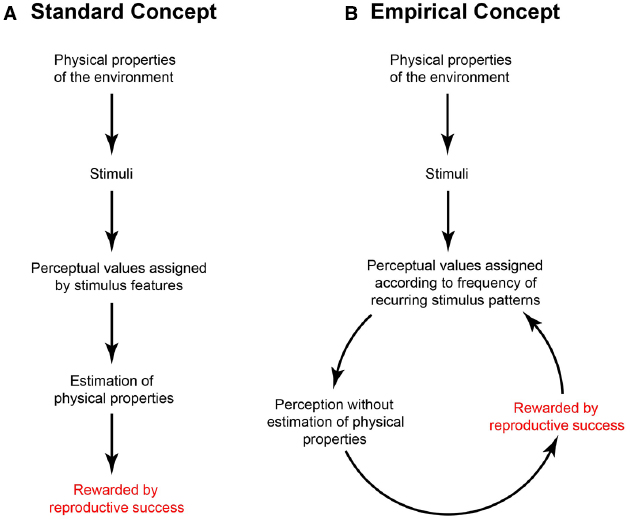
THE CAUSES OF DEFICIENT PERCEPTION /
307
perception (Chapter 11) then asserts itself, since pictorial attention interferes with attention to information. The compromise is not between the raw data and the complete processing of this data, but between two alternative kinds of attention. Some sorts of visual sensation, especially linear perspective, are very obtrusive, the more so when attention has been educated to it by having learned to draw pictures. The result may be the illusory appearance of foreshortened surfaces and decreasing size with distance. When this attitude is adopted, the information for the slant of the coin becomes a sensation of elliptical shape and the information for the recession of distance becomes a sensation of angular convergence to a vanishing point. I do not know of any good evidence to show that animals or young children are subject to these illusions of perspective.
Do young children see objects in perspective? When Helmholtz was a grown man he wrote about an event in his childhood supporting his assumption that visual sensations are what the inexperienced eye and brain provide. Having been taken to Potsdam and seeing people high up in the belfry of the church tower, he had exclaimed that they were dolls. From this incident he concluded that the seeing of objects in the distance as small is unlearned; seeing in proper size comes only with learning the clues for distance. But I would draw precisely the opposite conclusion from this story. The infant Helmholtz had been naively perceiving the constant scale of things all along; what this precocious observer noticed for the first time was that men in the distance could be said to look small. Indeed they can to the sophisticated selfobserver. Can we really believe that the young genius took the people to be dolls? Let us rather assume that he saw people but began to be aware of size perspective and of the puzzles of physiological optics. He later wrote a thousand-page treatise on the subject, so brilliant and convincing that his theory of 'unconscious inference' still dominates the textbooks a century later.
Another example of a sensory illusion is the finger which 'looks double' when held close to the eye. The dual sensations are the consequence of disparity of the two optic arrays (Chapter 9) and they are usually called double 'images.' A finger held at the tip of the nose with the eyes converging at a considerable distance yields crossed disparity, a maximum degree of it, in fact. Crossed disparity is information for the visual system specifying the nearness of the finger. Usually it is registered simply as information, but if one attends to his retinal sensations, after being trained to do so, one gets the curious illusion of two fingers, knowing full well that there is only one.
308 /
THE SENSES CONSIDERED AS PERCEPTUAL SYSTEMS
The doubling of contours in the visual field can only be noticed when it is relatively strong. It is not usually obtrusive and it does not seem to interfere with the pickup of disparity information. In the present theory, the double sensations are an incidental symptom of binocular disparity. But the theories of sensation-based perception must assume a fusion of these double images in the brain, or the 'sensorium,' and this leads to all sorts of theoretical trouble. After-effects of Habituation One of the physiological after-effects described above was that in which a hand is immersed in warm water for a minute. The feeling of warmth diminishes. Then if the hand is put in water at room temperature it feels cold. This is said to be a result of physiological adaptation, but it is analogous to many other kinds of adaptation or habituation that are called psychological. The principle seems to be that whenever opposites can be judged, an experience on one side of the scale tends to shift the judgment of what is neutral toward that side of the scale. There are innumerable instances of this central tendency in perceiving, judging, rating, and evaluating, at various levels of perception. At one level, a moderate illumination seems bright after one has been in darkness but dark after one has been in bright light. At quite another level, ordinary conversation seems brilliant after talking to dull people, but dull after talking to bright people. The principle applies not only to the qualities of objects that John Locke called secondary, but also to some that he called primary. The secondary qualities were colors, sounds, tastes, smells, and feelings of warmth and cold, and they were said to be only in us, not in the physical objects themselves. The primary qualities were shape, size, position, duration, motion, and solidity, and they were said to be in physical objects. Everything in this book, the reader will recognize, goes contrary to this doctrine of Locke's. It is plausible but pernicious, and the attempt to refute it was begun in the first chapters. The point of interest here is this: since after-effects in perception apply not only to colors, tastes, smells, and feelings of temperature, but also to shape, size, position, and motion, one reason for the doctrine breaks down. Here are the facts. After looking at a curved edge for some time, a straight edge appears to be slightly curved the other way (Gibson, 1933). After looking at a surface slanted backward, a frontal surface appears slanted forward (Bergman and Gibson, 1959). After wearing prismatic spectacles yielding a whole family of abnormalities in surface perception, their opposites appear when the spectacles are removed (Kohler, 1964). The perceptual process for these supposedly objective qualities is not
THE CAUSES OF DEFICIENT PERCEPTION /
309
different in this respect from the perceptual process for the colors and the temperatures of surfaces. The illusory negative after-effects in these cases are clearly the consequences of the adaptation or habituation. This might be a tendency to reset the neutral values of perceptual qualities to a running mean of environmental values. Something like this is suggested by Helson's theory of 'adaptation level' (Helson, 1964). Whatever the process, it is a realistic one and the occasional errors of judgment are incidental to it. Overselective Attention It was said earlier in this chapter that the perceptual systems did not get enough information to work with in some circumstances, such as fog and darkness. In other circumstances, however, they get too much information to work with. In an eventful environment with sights and sounds and smells and touches all around, the individual cannot register everything at once and his perception must therefore be selective. The modes of selective attention, in fact, define the principal perceptual systems. The number of different identifiable objects in different directions may be enormous, and no one can look at them all. The world is often like a three-ring circus to a child - too many things happening too fast for him to comprehend them. In the face of this situation, an expert perceiver develops a highly economical strategy of perception. This was described at the end of the last chapter. After things are discriminated and their properties abstracted, their number is reduced to a few categories of interest and the subcategories or cross-categories are neglected. At this stage only the information required to identify an object need be picked up and all the other information in the array, whatever makes it unique and special, can be neglected. Hence the percept of the object becomes a mere caricature or schema of what it would be if the perceiver took the time to scan the optical structure of the object. When he gives it only a glance, he neglects available information just as a tenth-second display of an object reduces available information. The tachistoscope forces observation at a glance. There is great danger of error, we may now note, in this kind of economical perception. The object may in fact be unique or special, that is, an exceptional one that is not in one of the observer's categories of interest. An overselection of information has occurred. What the object really affords may be missed and what the observer perceives it as affording may be mistaken. The danger of schematic perception is not so much that the percept is a caricature of the object and therefore an imperfect representation. A
310 /
THE SENSES CONSIDERED AS PERCEPTUAL
SYSTEMS
percept is never a representation in the first place. The danger is that the caricature may not be a good one. A clumsy caricature by a poor artist is not misleading because it is a distortion, but only because the information it conveys is wrong. The prejudgment involved in a skeletonized percept is a necessary result of the selective attunement of a perceptual system. If the prejudgments of conceptual attention are elaborate enough they will not get the observer into trouble. Prejudices and stereotypes are misleading when the interests of the observer are narrow or malicious. The prejudices of the open-minded observer are another matter.
A Classification
of Illusions
When our early ancestors first noticed the images in a pool of water, or the shadows of things, and especially when they began to make pictures, we may fairly assume that they became puzzled about the problem of appearance and reality. For these appearances are not real things; they are ghost-like, as the simplest of tests show. They are illusions. Illusions, as the Latin root of the word suggests, mock us. There are many kinds, and some are difficult to explain. It is difficult even to decide just what an illusion is. How, for example, does an illusion differ from an hallucination? Can we now, on the basis of what has been said, define and classify illusions? On the present theory, illusions, like misperceptions in general, should tend to fall into two major types, objective and subjective. I will suggest that those of the first type are caused by information from artificial sources, by the deflecting of light rays, by contradictory information from pictorial sources, and by obscure combinations of information in geometrical drawings. Those of the second type, on the other hand, arising from deficiencies of perception, seem to be caused by such factors as the aftereffects of excitation, insufficient specialization of receptors, and internal excitation of the nervous system. These seven classes of illusions are probably not exhaustive. They illustrate the possibility, however, of a general theoretical approach to a difficult and confusing problem in the study of perception. Artificial Sources
Perhaps the commonest illusions are representations or reproductions. These were defined in Chapter ll. The faithful picture, the painting, the wax flowers, the statue, and the model are examples. The rule is that if an artificial source of stimulation conveys information equivalent to a natural source, the perceptions will be to that extent equivalent.
THE CAUSES OF DEFICIENT PERCEPTION /
311
For vision the same structure (or transformation) of an optic array, whatever its source, will always afford the same perception. The virtual object behind a mirror is also the result of this rule. The motion picture is notoriously a case where the moving event is only apparent. Nothing in the window really moves, but insofar as the optical transformations in the light from the screen are the same as the transformations in the light from the event to the camera, an illusion will result. The virtual event may be highly convincing, as when the young child is distressed by the shadows of the hero and the villain knocking one another down with a display of violent gestures and facial expressions. He presumably has not learned to distinguish illusion from reality by spanning all the available information, including that outside the screen and that prior to or subsequent to the movie. Onstage fighting, of course, may be even more frightening to the child than motion-picture fighting. The optical motions produced by the gadgets used in psychological laboratories to isolate, control, and display them are also virtual but not real. The material rotation of a Plateau spiral (Figure 14.7) causes its optical array to undergo expansion or contraction. The device of a rotating spiral behind a slot causes an optical motion of linear translation. The motions of the apparatus are entirely distinct from the motions of the light. The rectangular room seen when a trapezoidal room is viewed from the proper peephole is another example. So are all the varieties of sound reproduction. If the fidelity of the system is high, there can be virtual orchestras, singers, speeches, or poetry readings. The Bending of an Optic Array by Reflection or Refraction
The image of oneself in a pool or mirror, in fact the whole virtual scene, is caused by regular reflection of the pencil of rays comprising an array (Figure 10.15). The mirage of unreal trees and buildings in the desert is said to be due to regular reflection at a layer of heated air, following the same principle. The apparent displacement of the visible environment and its objects by prisms in front of the eyes is due to refraction, which is another sort of bending of a pencil of rays. Apparent reversal of the world can be obtained by refraction and internal reflection in a right-angle prism. The straight stick that appears bent in water is due to refraction. If the differential scattering of light of different wavelengths by particles in air is reduced to a multitude of reflections and refractions, then the apparent blueness of mountains (which are really green) in the distance is indirectly due to this cause.
312 /
THE SENSES CONSIDERED AS PERCEPTUAL
SYSTEMS
Figure 14.7 A Plateau spiral. If the spiral line is smooth and the surface of the disk is blank, a slow rotation will yield no optical information for rotation but only optical information for a motion of expansion. This occurs with a counterclockwise rotation of the disk; the opposite occurs with clockwise rotation. The continuous centrifugal flow of the optic array is similar to that of approach, except that its outer border does not participate in the motion. A strange experience of approach (or of recession) not embodied in an object is often reported when the disk is observed in rotation. And a reversed after-image of the motion is observed when the rotation stops. Plateau was a nineteenth-century Belgian scientist who made many discoveries about vision. (From Edwin G. Boring, Sensation and Perception in the History of Experimental Psychology, Figure 95. Copyright, 1942, by D. Appleton-Century Company, Inc. Reprinted by permission of Appleton-CenturyCrofts, Division of Meredith Publishing Company.)
Contradictory Information from a Picture
The illusions that can be described as the seeing of two alternative things in the same place were explained in Chapter 11 as cases of equivocal information in the same array. The reversibility of figure and ground and of perspective depth were illustrated. Other examples of hidden representations and various sorts of puzzle pictures are familiar to painters and psychologists. The contradictions of optical structure that can be incorporated in a drawing or painting are endless, and it seems to be fashionable just now for artists to explore them. The Geometrical Illusions
There is a large class of visual illusions, known to psychologists for a century, that do not involve representation but only the perception of
THE CAUSES OF DEFICIENT PERCEPTION /
313
the properties of lines, curves, and geometrical figures. They involve the judgment of apparent lengths, sizes, angles, and areas, and of rectilinearity, parallels, and the like. These are variables of optical structure, of structure as such in the present terminology, but they are variables of relatively low order. They come from plane geometry, not from the relational invariants of perspective or projective geometry, which, I argue, carry most of the information about the world. Length, size, and angle are basic variables for measurement, and it has been assumed that they must also be basic variables of visual sensation or perception, but that assumption has here been challenged. According to Titchener (1906, VoL I, Part 1), a geometrical illusion is 'a perception which differs in some way from the perception which the nature of the visual stimuli would lead us to expect' (p. 151). The stimuli compared in the Miiller-Lyer figure are essentially two lines of equal length. We would expect equal lengths to appear equal but they do not. Similarly, we would expect segments of the same line to appear co-linear, and parallels to appear parallel, for these are properties of the stimuli, and presumably of the corresponding sensations. These are illustrated in Figure 14.8. But the information for length of line, I have argued, is not simply length of line. To suppose so is to confuse the picture considered as a surface with the optical information to the eye. A line drawn on paper is not a stimulus. The stimulus information for the length of a line is altered by combining it with other lines. We should never have expected equal lengths to appear equal when they are incorporated in different figures. Only if we can isolate the two line segments from the wings and arrowheads in the Miiller-Lyer illusion should they appear equal, and this would require a very special kind of selective attention. The question of why one line looks shorter than the other is no longer of major importance for the theory of perception if line segments as such are not components of perception. The answer depends on discovering combinations of information in line drawings. Of all the many theories of the Miiller-Lyer illusion, the one most nearly consistent with our hypothesis is one of this sort: the left-hand figure contains information for the ridge of a roof seen from above, while the right-hand figure contains information for the ridge of a roof seen from below. The apparent sizes of the two ridge-lines depend on their apparent distances in accordance with the general principle of perception of size-at-a-distance illustrated in Figure 14.9. If this hypothesis is valid, the geometrical illusions are not subjective phenomena as they have always been taken to be, but instead are special cases of the information in variables of optical structure as displayed in drawings.
Zollner
Muller-Lyer
Poggendorff
Hering
Wundt
Figure 14.8 The better known geometrical illusions. Anomalies in the perception of the lengths of lines, the parallelism of lines, the sizes of outlines, the continuity of a line, and the rectilinearity or curvature of lines are illustrated. The illusions are named for their discoverers. (From E. B. Titchener, Experimental Psychology, Vol. I, Qualitative Experiments, Student's Manual. Copyright 1909, The Macmillan Company. Reprinted by permission of the publisher.)
THE CAUSES OF DEFICIENT PERCEPTION
/
315
Figure 14.9 The principle of the perception of size-at-adistance. One kind of information for detecting the size of an
object that is part of a terrestrial environment consists of the amount of environmental texture the object intercepts or hides. The far cylinder in this scene is more than twice as large as the near one because it intercepts more than twice as many units of texture. Hence, in a pictorial array, the length of a line on the picture-plane can scarcely be seen as such; there is a strong tendency for it to be perceived as the length of the object it represents in the virtual space of the picture. (From Gibson, 1950.)
316 /
THE SENSES CONSIDERED AS PERCEPTUAL SYSTEMS
After-effects of Excitation
We now come to those classes of illusions that are genuinely subjective phenomena. The after-sensations of light and color, of warmth and cold, and of rotation were described in the last section. As explained, they result from unusual conditions of stimulation, staring at a source, change of medium, and passive rotation, respectively. The neural input continues after stimulation has ceased. The perceptual after-effects of habituation, the apparent curvatures and motions of the world described, are a little different. They are ultimately but not so obviously physiological in origin. Distortions of the shape and motion of things look as if they were external but they are just as dependent on neural processes as the patch of color that moves with the eye or the spots that sometimes appear with migraine. Insufficient Specialization of Receptors
The so-called flashes of light that appear when the skull is severely jarred are a result of mechanical stimulation of the visual nervous system, that is, of cells that are supposed to respond only to light. Pressure on the eyeball can also excite the retina. This perceptual system is fairly well cushioned against bumps, but some are too much for it. Electrical stimulation, which fortunately is rare in life, will excite any receptor mosaic or any nervous tissue - eye, ear, skin, or muscle. Illusions of light, sound, touch, or action due to electric shock are not encountered unless one is the subject of an experiment. The photoreceptive equipment is well specialized for photoreception, but not perfectly so, and mechanical or electrical energy can touch it off. None of the perceptual systems is perfectly specialized for the pickup of information. If there is no limit to potential information, perfection of discrimination is not to be expected. The tasting system, as noted in Chapter 8, is subject to a kind of illusion inasmuch as some harmful poisons do not arouse distaste, and conversely, some harmless emetics do arouse distaste. For an omnivorous species like man, not all environmental substances are differentiated with respect to their nutritive value. There are too many substances. Some things that are not nutritive are palatable, and some things that are nutritive are unpalatable. Internal Excitation of the Nervous System
The false feeling of pain or other sensation in an amputated limb is an impressive demonstration of the fact that perception depends on impulses in nerve fibers and that nerve fibers fire in sequential chains. Where the excitation begins in the case of the feeling of a 'phantom limb' is not known, but it is known that nerves are discharged by abnormal causes,
THE CAUSES OF DEFICIENT PERCEPTION /
317
especially after injury, and sometimes long after. Drugs can have a direct effect on nervous tissue, as in the false colors of things observed after taking mescaline. And with alcohol poisoning, or the new 'psychomimetic' drugs, full hallucinations may arise as a result of direct action on the brain. Hallucinations, it is said, are accompanied by a 'feeling of reality,' whereas illusions are not. Just what the feeling of reality consists of has not been established. Probably it is graded in degree. One clue to this gradation might be obtained by considering the continued efforts that have been made since the invention of photography to 'add realism' to a picture, to make it lifelike, in short to make this classic type of illusion as much as possible like a perception (Chapter 11). The stationary, black-and-white screen picture produced by the early 'magic lantern' was soon given color, and the fidelity of color representation has since been radically improved. The scope of the screen has been increased in the attempt to create a panorama. The stereoscopic picture was invented in the effort to enhance the perception of depth. The representation of sequence and transformation was achieved by cinematography. The sound film supplied auditory representation synchronized with the visual representation in recent times. We now have the panoramic motion picture in color with sound. These developments have all made available more information to the main perceptual systems, vision and hearing. The perceiver does indeed get an approximation to first-hand experience nowadays, especially if the motion-picture camera takes the position of an actor in the scene. Nevertheless, the modern motion picture is not an hallucination. It is still mere illusion. All proprioception is absent except for eye movements. The perceiver is passive. He sits in a chair. He is not fully surrounded by the environment represented on the screen. He cannot alter what will happen in the virtual world. Even though he may be given the experience of walking, approaching, inspecting, and riding in vehicles, it is not his experience for he did not get it for himself; most of it is imposed, not obtained. The perception of a real world cannot and never will be completely imitated, for in the real world the perceiver can always find out things for himself and the more he explores the more he will find. The malfunctioning of the perceptual systems which leads to true hallucinations, as in serious mental diseases, is probably due to some kind of inhibition of perceptual exploration with a shutting off or rejection of the current input of perceptual information.
318 /
THE SENSES CONSIDERED AS PERCEPTUAL SYSTEMS
Summary In this final chapter an attempt has been made to explain misperceptions and illusions as deficiencies in a process which usually comes out right but which for various reasons sometimes goes wrong. A tentative list of these reasons has been offered. First, the available stimulus information for perception can be inadequate. The energy may be minimal, or the structure of an array may be blurred, or it can be masked, or the information in structure may be contradictory. The interval during which energy is available may be cut short, or the angular size of the optic array may be narrowed down. The spatial and temporal structure of light or sound can be displaced, or biased, or distorted. Mirrors, prisms, and lenses can alter the structure of light and modern electronic gadgetry can alter the structure of sound. Second, the physiological process of information pickup can be deficient. Even normal perceptual organs fail to work at high intensities of energy. Their capacity can be overstrained. They get out of calibration after abnormal stimulation and the recovery process then yields aftersensations. The physiological action of the receptors as such may be so obtrusive as to distract the observer. The action of a whole system may be subject to perceptual adaptation followed by after-effects. And finally there are errors of attention due to false expectations. These causes of misperception provide at least a systematic basis for the classification of what have been called illusions. Some illusions should be ascribed mainly to external conditions and some mainly to internal. Examples of the former are experiences aroused by artificial sources (images and reproductions, including motion pictures); experiences resulting from the bending of optic arrays by natural or artificial means; the ambiguous experiences from contradictory information in a picture; and the anomalies of the 'geometrical' illusions. Examples of the latter are the after-sensations and perceptual after-effects, the sensations caused by inappropriate mechanical or electrical stimulation, and the little understood cases of purely internal excitation of the nervous system. The last-named include hallucinations.
Conelusion
Thomas Reid's assertion in 1785 is just as true as it ever was, that 'the external senses have a double province; to make us feel and to make us perceive.' They 'furnish us with a variety of sensations' and they 'give us a conception of external objects.' Philosophers and psychologists have been fascinated by these feelings that accompany perceiving, and physiologists have discovered some of their causes. But animals and children and ordinary persons are not in the least concerned with how it feels to perceive. When the senses are considered as channels of sensations they are curious and interesting, but they are not the instruments of our contact with the world. The impressions of sense are incidental accompaniments of perceiving, not the data for perceiving. They are not entailed in perceiving. Sensations are not, as we have always taken for granted, the basis of perception. When the senses are considered as perceptual systems, all theories of perception become at one stroke unnecessary. It is no longer a question of how the mind operates on the deliverances of sense, or how past experience can organize the data, or even how the brain can process the inputs of the nerves, but simply how information is picked up. This stimulus information is available in the everyday environment, as I have shown. The individual does not have to construct an awareness of the world from bare intensities and frequencies of energy; he has to detect the world from invariant properties in the flux of energy. Such invariants, the direction of gravity for instance, are registered even by primitive animals who do not have elaborate perceptual organs. Mathematical complexities of stimulus energy seem to be the simplicities of stimulus information. Active perceptual systems, as contrasted with passive receptors, have so developed during evolution that they can resonate to this information. The mathematically simple and easily measurable variables of energy are bare of meaning, to be sure, but they 319
320 /
THE SENSES CONSIDERED AS PERCEPTUAL SYSTEMS
are only relevant to the action of mechanoreceptors, photoreceptors, and chemoreceptors. When it is recognized that receptors, nerve bundles, and the corresponding modalities of sensory experience do not provide a fixed number of senses or permit a fixed inventory of sense impressions, we are free to study the redundant overlapping activity of perceptual systems unhindered by the old doctrines. Proprioception or self-sensitivity is seen to be an overall function, common to all systems, not a special sense. The activity of orienting and that of exploring and selecting - the commonsense faculty of attending - is seen to be one that extracts the external information from the stimulus flux while registering the change as subjective feeling. This feedback system also, of course, controls the performatory activity of the body, the executive systems of behavior proper as distinguished from perception, but that aspect of proprioception lies outside the scope of this book. The puzzle of constant perception despite varying sensations disappears and a new question arises, how the invariant information is extracted. Perceptual development and perceptual learning are seen as a process of distinguishing the features of a rich input, not of enriching the data . of a bare and meaningless input. A perceptual system hunts for a state of what we call 'clarity.' Whatever this state is physiologically, it has probably governed the evolution of perception in the species, the maturation of perception in the young, and the learning of perception in the adult. The puzzle of depth perception disappears and the question becomes one of how animals detect the layout of their surroundings. The puzzle of form perception is no longer important (consisting only of the question of how men learned to see the perspectives of things from this or that point of view when they began to draw pictures) and the important question emerges of how animals and children detect those distinctive features of things that are invariant under changes of perspective. The puzzle evaporates of the seemingly innate capacity of newborn animals and human infants to interpret certain sensations without prior experience. Instead, the question arises of how it is that vision, hearing, and smell are attuned to (or are rapidly imprinted by) certain sights, sounds, and odors. Above all, the puzzle of meaning and value in perception takes an entirely new form. If what things afford is specified in the light, sound, and odor around them, and does not consist of the subjective memories of what they have afforded in the past, then the learning of new meanings is an education of attention rather than an accrual of associations. The problem of the communication of information from one person to another also takes a new form. Pictures and words are now seen to be
CONCLUSION
/
321
truly mediators of perception, of perception at second hand. Spoken and written words presuppose a code, and associative learning of the classical sort does come into the child's mastery of this code. But association is not the basis of learning as we have been taught. Discrimination has to precede association for language to be of any use. The ability to name and to predicate fixes the gains of perceiving but it does not explain perceiving. It fosters the education of attention to the facts of the world but cannot substitute for it. The useful senses have been contrasted in this book with what might be called the useless senses. The fact is that, although different men do not all use their senses in the same way, they can all use their senses in the same way. The basis for agreement among men exists in the available stimulus information. Men often disagree but they are not fated to do so by their language or their culture. Disagreement is not caused by inherent differences in their habits of interpreting sensory experience - habits permanently fixed by the words they use. A man can always re-educate his attention. For that matter, a man can invent new words for something he has seen for himself. He can even get others to see what he has newly seen by describing it carefully, and this is a fortunate man. Let us recognize the strength of the dead hand of habit on perception. Let us acknowledge that people - other people, of course - often perceive the world like silly sheep. But it is wrong to make a philosophy of this rather snobbish observation. The orthodox theories of perception have encouraged this fallacy and one purpose of this book has been to undermine them. This book is dedicated to all persons who want to look for themselves.
BIBIIOGRAPHf
The Senses Considered As Perceptual Systems Gibson Pdf Download Pc
Adey, W. R, The sense of smell, Chapter 21 in Handbook of Physiology, Vol. 1, Neurophysiology, American Physiological Society, 1959. Allee, W. C., A. E. Emerson, O. Park, T. Park, and K. P. Schmidt, Principles of Animal Ecology, Saunders, 1949. Ambrose, J A., The development of the smiling response in early infancy. In B. M. Foss (Ed.), Determinants of Infant Behavior, Wiley, 1961. Arnheim, R, Art and Visual Perception, University of California Press, 1954. Attneave, F., Applications of Information Theory to Psychology, Holt, 1959. Ausubel, D. P., Theory and Problems of Child Development, Grune and Stratton, 1958. Autrum, H., Nonphotic receptors in lower forms. Chapter 16 in Handbook of Physiology. Vol. 1, Neurophysiology, American Physiological Society, 1959. Bergman R., and J. J. Gibson, The negative aftereffect of the perception of a surface slanted in the third dimension. Amer.]. Psychol., 1959, 72, 364-374. Berkeley, G., An Essay Towards a New Theory of Vision, 1709 (any modern edition) . Bevan, W., Subliminal stimulation: A pervasive problem for psychology. Psychol. Bull., 1964, 61, 81-99. Binns, H., Visual and tactual judgment as illustrated in a practical experiment. Brit. t. Psychol., 1937, 27, 404-410. Boring, E. G., Sensation and Perception in the History of Experimental Psychology, Appleton-Century, 1942. Boring, E. G., Visual perception as invariance. Psychol. Rev., 1952a, 59, 141148. Boring, E. G., The Gibsonian visual field. Psychol. Rev., 1952b, 59, 246-247. Bosma, J. F. (Ed.), Symposium on Oral Sensation and Perception, Thomas, 1966. Broadbent, D. E., Perception and Communication, Pergamon Press, 1958. Brunswik, E., Systematic and Representative Design of Psychological Experiments, University of California Press, 1949.322
The Senses Considered As Perceptual Systems Gibson Pdf Downloads
BIBLIOGRAPHY/
323
Brunswik, K, Perception and the Representative Design of Psychological Experiments, University of California Press, 1956. Cannon, W. B., Bodily Changes in Pain, Hunger, Fear, and Rage, Appleton, 1929. Carmichael, L., and W. F. Dearborn, Reading and Visual Fatigue, Houghton Mifflin, 1947. Cherry, C., On Human Communication, Wiley, 1957. Clifford, W. K., The Common Sense of the Exact Sciences, Knopf, 1946. Cohen, W., Spatial and textural characteristics of the Ganzfeld. Amer.]. Psychol., 1957, 70, 403-410. Daniel, G., Lascaux and Carnac, London: Lutterworth Press, 1955. Davis, H., Excitation of auditory receptors. Chapter 23 in Handbook of Physiology. Vol. 1, Neurophysiology, American Physiological Society, 1959. Eddington, A. S.,
The Nature of the Physical World, Macmillan, 1929.
Fantz, R L., The origin of form perception. Sci. Amer., 1961, 204, 2-8. Fieandt, K. von, and J. J. Gibson, The sensitivity of the eye to two kinds of continuous transformation of a shadow-pattern. l- Esper. Psychol., 1959, 57, 344-347. Flock, H. R, A possible optical basis for monocular slant perception. Psychol. Rev., 1964, 71, 380-391. Fraenkel, G. S., and D. L. Gunn, The Orientation of Animals, Oxford University Press, 1940 (Dover, 1961). Frisch, K. von, Bees: Their Vision, Chemical Senses, and Language, Cornell University Press, 1960. Fry, G. A., Review of Ronchi's Optics. [, Opt. Soc. Amer., 1957, 47, 977-978. Garner, W. R, Uncertainty and Structure as Psychological Concepts, Wiley, 1962. Geldard, F. A., The Human Senses, Wiley, 1953. Gibson, Eleanor J., Improvement in perceptual judgments as a function of controlled practice or training. Psychol. Bull., 1953, 50, 401-431. Gibson, Eleanor J., J. J. Gibson, O. W. Smith, and H. Flock, Motion parallax as a determinant of perceived depth. [, Exper. Psychol., 1959, 58, 40-51. Gibson, J. J., Adaptation, aftereffect, and contrast in the perception of curved lines. t. Exper. Psychol., 1933, 16, 1-31. Gibson, J. J., Adaptation with negative aftereffect. Psychol. Rev., 1937, 44, 222-244. Gibson, J. J., A critical review of the concept of set in contemporary experimental psychology. Psychol. Bull., 1941, 38, 781-817. Gibson, J. J., Studying Perceptual Phenomena. Chapter 6 in T. G. Andrews (Ed.), Methods of Psychology, Wiley, 1948. Gibson, J. J., The Perception of the Visual World, Allen and Unwin, 1952. Gibson, J. J., The visual field and the visual world: A reply to Professor Boring. Psychol. Rev., 1952a, 59, 149-151.
324 /
THE SENSES CONSIDERED AS PERCEPTUAL SYSTEMS
Gibson, J. J., The relation between visual and postural determinants of the phenomenal vertical. Psychol. Rev., 1952b, 59, 370-375. Gibson, J. J., A theory of pictorial perception. Audiovisual Communic. Rev., 1954a, 1, 3-23. Gibson, J. J., The visual perception of objective motion and subjective movement. Psychol. Rev., 1954b, 61, 304-314. Gibson, J. J., Optical Motions and Transformations as Stimuli for Visual Perception (motion picture). Psychological Cinema Register, State College, Pa., 1955. Gibson, J. J., Optical motions and transformations as stimuli for visual perception. Psychol. Rev., 1957, 64, 288-295. Gibson, J. J., Visually controlled locomotion and visual orientation in animals. Brit. ]. Psychol., 1958, 49, 182-194. Gibson, J. J., Perception as a function of stimulation. In S. Koch (Ed.), Psychology: A Study of a Science, Vol. 1, McGraw-Hill, 1959. Gibson, J. J., The concept of the stimulus in psychology. Amer. Psychol., 1960a, 15, 694-703. Gibson, J. J., Pictures, perspective, and perception. Daedalus, 1960b, 89, 216227. Gibson, J. J., Ecological optics, Vision Research, 1961, 1, 253-262. Gibson, J. J., Observations on active touch. Psychol. Rev., 1962, 69, 477-491. Gibson, J. J., The useful dimensions of sensitivity. Amer. Psychol., 1963, 18, 1-15. Gibson, J. J., and Eleanor J. Gibson, Perceptual learning: differentiation or enrichment? Psychol. Rev., 1955, 62, 32-41. Gibson, J. J., and Eleanor J. Gibson, Continuous perspective transformations and the perception of rigid motion. ]. Exper. Psychol., 1957, 54, 129-138. Gibson, J. J., and F. A. Backlund, An aftereffect in haptic space perception. Quart. ]. Exper. Psychol., 1963, 15, 145-154. Gibson, J. J., P. Olum, and F. Rosenblatt, Parallax and perspective during aircraft landings. Amer.]. Psychol., 1955, 68, 372-385. Gibson, J. J., and Anne D. Pick, Perception of another person's looking behavior. Amer. ]. Psychol., 1963, 76, 386-394. Gibson, J. J., J. Purdy, and L. Lawrence, A method of controlling stimulation for the study of space perception: The optical tunnel. ]. Exper. Psychol., 1955,50, 1-14. Gibson, J. J., and D. Waddell, Homogeneous retinal stimulation and visual perception. Amer.]. Psychol., 1952, 65, 263-270. Goldscheider, A., Gesammelte Abhandlungen von A. Goldscheider (2 vols.), Leipzig: Barth, 1898. Gombrich, E. H., Art and Illusion: A Study in the Psychology of Pictorial Representation, Pantheon, 1960. Gottschaldt, K., Uber den EinHuss der Erfahrung auf die Wahrnehmung von Figuren. Psychol. Forsch., 1926, 8, 261-317. Graham, C. H., Color theory. In S. Koch (Ed.), Psychology: A Study of a Science, Vol. 1, Sensory, Perceptual, and Physiological Formulations, pp. 145-287, McGraw-Hill, 1959.
BIBLIOGRAPHY
/
325
Gray, J. A. B., Initiation of impulses at receptors. Chapter 4 in Handbook of Physiology. Vol. 1, Neurophysiology, American Physiological Society, 1959. Harlow, H. F., The nature of love. Amer. Psychol., 1958, 13, 673-685. Harper, R, Physiological and psychological aspects of studies of craftsmanship in dairying. Brit.]. Psychol. Monogr. Suppl., 1952, 28, 1-63. Harper, R, and S. S. Stevens, Subjective hardness of compliant materials. Quart. ]. Exper. Psychol., 1964, 16, 204-215. Harris, C. S., Adaptation to displaced vision: visual, motor, or proprioceptive change? Science, 1963, 40, 812-813. Hasler, A. D., and W. J. Wisby, Discrimination of stream odors by fishes and its relation to parent stream behavior. Amer. Naturalist, 1951, 85, 223-238. Hebb, D.O., The Organization of Behavior, Wiley, 1949. Heider, F., Ding und Medium, Symposion, 1926, 1, 109-157. Translated as 'Thing and medium,' in F. Heider, On Perception, Event Structure, and Psychological Environment, International Universities Press, 1959 (Psychological Issues, 1959, Vol. 1, No.3). Held, R, Plasticity in sensory-motor systems. Sci. Amer., 1965, 213, 84-94. Helmholtz, H., Phusiological Optics, Vol. 3 0. P. C. Southall, Ed.), Optical Society of America, 1925. Helson, H., Adaptation-Level Theory, Harper and Row, 1964. Hochberg, J. E., Perception, Prentice-Hall, 1964. Hochberg, J. E., and J. Beck, Apparent spatial arrangement and perceived brightness. ]. Exper. Psychol., 1954, 47, 263-266. Hockett, C. F., and R Ascher, The human revolution. Current Anthropol., 1964, 5, 135-168. Holst, E. von, Relations between the central nervous system and the peripheral organs. Brit.]. Anim. Behav., 1954, 2, 89-94. Holst, E. von, and H. Mittelstadt, Das reafferenzprinzip. Naturwiss, 1950, 37, 464-476. Hornbostel, E. M. von, The unity of the senses. Psyche, 1927, 7, 83-89. Reprinted in W. D. Ellis, A Source Book of Gestalt Psychology, Harcourt Brace, 1938. Hull, C. L., Principles of Behavior, Appleton-Century, 1943. Hume, D., A Treatise of Human Nature, 1739 (any modem edition). Humphrey, G., Thinking, An Introduction to its Experimental Psychology, London: Methuen, 1951. Hurvich, L. M., and Dorothea Jameson, The Perception of Brightness and Darkness, Allyn & Bacon, 1966. Hutchinson, Ann, Labanotation, New Directions, 1954. Jakobson, R, and M. Halle, Fundamentals of Language, The Hague: Mouton and Co., 1956. James, W., The Principles of Psychology, Holt, 1890. Jennings, H. S., Behavior of the Lower Organisms, Macmillan, 1906. Johansson, G., Configurations in Event Perception, Uppsala: Almkvist and Wiksell, 1950.
326 /
THE SENSES CONSIDERED AS PERCEPTUAL
SYSTEMS
Kalmus, H., The discrimination by the nose of the dog of individual human odors and in particular of the odors of twins. Brit.]. Anim. Behav., 1955, 3,25-31. Kalmus, H., The chemical senses. Sci. Amer., 1958, 198, 97-106. Kare, M., and M. S. Ficken, Comparative studies on the sense of taste. In Y. Zotterman (Ed.), Olfaction and Taste, Macmillan, 1963. Katz, D., Der Aufbau der Tastwelt, Leipzig: Barth, 1925. Katz, D., The World of Colour (Tr. by R B. MacLeod and C. W. Fox), London: Kegan Paul, Trench, Trubner and Co., 1935. Katz, D., A sense of touch. The techniques of percussion, palpation, and massage. Brit.]. Phys. Med., 1936, 2, 35ff. Katz, D., and W. Stephenson, Experiments on elasticity. Brit.]. Psychol., 1937, 28, 190-194. Katz, D., and R B. MacLeod, The mandible principle in muscular action. Acta Psychol., 1949, 6, 33-39. Kelvin, R P., Discrimination of size by sight and touch. Quart. ]. Exper. Psychol., 1954, 6, 23-34. Kepes, G., The Language of Vision, Geo. Theobald, 1944. Kluver, H., Behavior Mechanisms in Monkeys, University of Chicago Press, 1933. Koffka, H., Principles of Gestalt Psychology, Harcourt Brace, 1935. Kohler, I., The Formation and Transformation of the Perceptual World (Tr. by H. Fiss) , International Universities Press, 1964 (Psychological Issues, 1964, Vol. 3, No.4). Originally Uber Aufbau und Wandlungen der Wahrnehmungswelt, Vienna: R. M. Rohrer, 1951. Kohler, W., The Mentality of Apes (Tr. by E. Winter), London: Routledge and Kegan Paul, 1925. Kohler, W., Gestalt Psychology, Liveright, 1929. Kohler, W., and D. Dinnerstein, Figural after-effects in kinesthesis. In Miscellanea Psychologica Albert Michotte, Louvain: Editions de I'Institut Superieur de Philosophie, 1949, pp. 196-220. Lashley, K. S., Brain Mechanisms and Intelligence, University of Chicago Press, 1929. Lashley, K. S., In search of the engram. In Physiological Mechanisms in Animal Behaviour (Symposium No.4, Soc. Exper. Biol.i , Academic Press, 1950. Lashley, K. S., The problem of serial order in behavior. In L. A. Jeffress (Ed.), Cerebral Mechanisms in Behavior: The Hixon Symposium, Wiley, 1951. LeBarre, W., The Human Animal, University of Chicago Press, 1954. Lewin, K., Dynamic Theory of Personality, McGraw-Hill, 1935. Lewin, K., Principles of Topological Psychology, McGraw-Hill, 1936. Liberman, A., K. S. Harris, P. Eimas, L. Lisker, and J. Bastian, An effect of learning on speech perception: The discrimination of durations of silence with and without phonemic significance. Language and Speech, 1961, 4, 175-195. Licklider, J. C. R, Basic correlates of the auditory stimulus. Chapter 25 in S. S. Stevens (Ed.), Handbook of Experimental Psychology, Wiley, 1951.
BIBLIOGRAPHY
/
327
Luckiesh, M., Visual Illusions, Van Nostrand, 1922. J
MacLeod, R. B., An experimental investigation of brightness constancy. Arch. Psychol., 1932, No. 135. Matthews, L. H., and M. Knight, The Senses of Animals, Philosophical Library, 1963. Metzger, W., Gesetze des Sehens, Frankfort am Main: Waldemar Kramer, 1953. Michotte, A., The Perception of Causality (Tr. by T. R. Miles and E. Miles), London: Methuen, 1963. Michotte, A., G. Thines, and G. Crabbe, Les complements amodaux des structures perceptives. Studia Psychologica, Louvain: Publ. Univ. de Louvain, 1964. Mill, J. S., An examination of Sir WiUiam Hamilton's Philosophy. London, 1865. Milne, L. J., and M. Milne, Photosensitivity in invertebrates. Chapter 26 in Handbook of Physiology. Vol. 1, Neurophysiology, American Physiological Society, 1959. Milne, L. J., and M. Milne, The Senses of Animals and Men, Atheneum, 1962. Montessori, M. Montessori Method (Tr. by A. S. George), Stokes, 1912. Moorhouse, A. c., The Triumph of the Alphabet, Henry Schuman, 1953. Nafe, J. P., The pressure, pain, and temperature senses. Chapter 20 in C. Murchison (Ed.), Handbook of General Experimental Psychology, Clark University Press, 1934. Ogden, C. K., and I. A. Richards, The Meaning of Meaning, 3rd ed., London: Kegan Paul, 1930. Pavlov, I. P., Conditional Reflexes (Tr. by G. V. Anrep), Oxford University Press. 1927. Pfaffman, C., The sense of taste. Chapter 20 in Handbook of Physiology. Vol. 1, Neurophysiology, American Physiological Society, 1959. Piaget, J., The Language and Thought of the Child (Tr. by M. Gabain), Humanities Press, 1951. Piaget, J., The Construction of Reality in the Child (Tr. by M. Cook), Basic Books, 1954. Piaget, J., and B. Inhelder, The Child's Conception of Space (Tr. by F. J. Langdon and J. L. Lunzer), Humanities Press, 1956. Pieron, H., The Sensations (Tr. by M. H. Pirenne and B. C. Abbott), London: J. Gamet Miller, 1952. Pirenne, M. H., Physiological mechanisms of vision and the quantum nature of light. Biol. Rev., 1956, 31, 194-241. Polyak, S. L., The Vertebrate Visual System, University of Chicago Press, 1957. Prince, J. H., Comparative Anatomy of the Eye, C. C. Thomas, 1956. Purdy, W. c., The hypothesis of psychophysical correspondence in space perception. Doctoral dissertation, Cornell University. Ann Arbor: University Microfilms, 1958, No. 58-5594. Reproduced in part as Report No. R60ELC56 of the General Electric Technical Information Series.
328 /
THE SENSES CONSIDERED AS PERCEPTUAL SYSTEMS
Reid, T., Essays on the Intellectual Powers of Man, 1785 (any modem edition). Revesz, G., Psychology and Art of the Blind, Longmans, Green, 1950. Reynolds, H., Factors affecting the accuracy of visual tracking of a moving object when it has disappeared from sight (Thesis). Cornell University Library, 1966. Ronchi, V., Optics: The Science of Vision (Tr. by E. Rosen), New York University Press, 1957. Rose, J. E., and V. B. Mountcastle, Touch and kinesthesis. Chapter 17 in Handbook of Physiology. Vol. 1, Neurophysiology, American Physiological Society, 1959. Schiff, W., Perception of impending collision: A study of visually directed avoidant behavior. Psychol. Monogr. 1965, 79, Whole No. 604. Schiff, W., J. A. Caviness, and J. J. Gibson, Persistent fear responses in Rhesus monkeys to the optical stimulus of 'looming.' Science, 1962, 136, 982-983. Schlosberg, H., Stereoscopic depth from single pictures. Amer. ]. Psychol., 1941, 54, 601-605. Senden, M. von, Space and Sight (Tr. by P. Heath), London: Methuen, 1960. Sheppard, D., The sensory basis of the cheese-grader's skill. Occup. Psychol., 1955, 29, 150-163. Sherrington, C. S., The Integrative Action of the Nervous System, Cambridge University Press, 1906. Singer, C., E. J. Holmyard, and A. R. Hall, A History of Technology, Oxford University Press, 1954. Skinner, B. F., The Behavior of Organisms, Appleton-Century, 1938. Stebbing, L. S., Philosophy and the Physicists, London: Methuen, 1937. Stevens, S. S. (Ed.), Handbook of Experimental Psychology, Wiley, 1951. Stevens, S. S., and Judith R. Harris, The scaling of subjective roughness and smoothness. l. Exper. Psychol., 1962, 64, 489-494. Stratton, G. M., Some preliminary experiments on vision without inversion of the retinal image. Psychol. Rev., 1896, 3, 611-617. Stratton, G. M., Vision without inversion of the retinal image. Psychol. Rev., 1897, 4, 341-360, 463-481. Taylor, B., Linear Perspective, London, 1715 (rev. ed., 1719). Thorpe, W. H., Learning and Instinct in Animals, Harvard University Press, 1956. Tinbergen, N., The Study of Instinct, Oxford University Press, 1951. Tolman, E. c., Purposive Behavior in Animals and Men, Century, 1932. Titchener, E. B., Experimental Psychology, 4 vols., Macmillan, 1906. Titchener, E. B., Textbook of Psychology, Macmillan, 1910. Troland, L. T., The Principles of Psychophysiology. Vol. 1, Problems of Psychology and Perception, 1929; Vol. 2, Sensation, 1930; Vol. 3, Cerebration and Action, 1932; Van Nostrand. Vernon, Magdalen D., A Further Study of Visual Perception, Cambridge University Press, 1952.
BIBLIOGRAPHY
/
329
Walk, R. D., and Eleanor J. Gibson, A comparative and analytical study of visual depth perception. Psychol. Monogr., 1961, 75, Whole no. 519. Wallach, H., The role of head movements and vestibular and visual cues in sound localization. l, Exper. Psychol., 1940, 27, 339-368. Reprinted in D. C. Beardslee and M. Wertheimer, Readings in Perception, Van Nostrand, 1958. Wallach, H., On sound localization. I. Acoust. Soc. Amer., 1939, 10, 270274. Reprinted in D. C. Beardslee and M. Wertheimer, Readings in Perception, Van Nostrand, 1958 Walls, G. L., The Vertebrate Eye and its Adaptive Radiation, Cranbrook Institute of Science, 1942. Ware, W. R., Modern Perspective, Macmillan, 1900. Wertheimer, M., Productive Thinking, Harper, 1945. Wever,E. G., Theory of Hearing, Wiley, 1949. Wever, E. G., and M. Lawrence, Physiological Acoustics, Princeton University Press, 1954. Whorf, B. L., Language, Thought, and Reality (Ed. by J. B. Carroll), Wiley, 1956. Woodworth, R. S., Experimental Psychology, Holt, 1938. Woodworth, R. S., Reinforcement of perception. Amer.]. Psychol., 1947, 60, 119-124.
Index In general the items included in this Index do not include the topics listed systematically in the Table of Contents. Instead, the more traditional terms and facts of sense perception are here included. Authors are included when their contributions are important for the text but not when the references are merely supportive. For the full list of references, see the Bibliography.
Blind spot, 263 Body image, 113 Boring, E. G., 38, 48, 111, 113, 11.5, 149,237,252,266,276 Broadbent, D. E., .51 Brunswik, E., 141, 187
Accommodation of lens, 172, 258 Adaptation level, 122, 309 Adaptation, temperature, 130f. Aerial perspective, 291£. After-effects, 308f. After-images, 2, 262, 305f. After-sensations, see After-images Air, as a medium, 14, 191£. Air, composition of, 18, 144 Alphabet, 27, 242-244 Allee, W. E., 30 Animals, senses of, 49 Aristotle, 48 Attention, education of, 51£. modes of, 49-51, 84, 268 visual, 259-262 Autokinetic phenomenon, 299
Backlund, F., 118, 122 Bell, c., 38, III Berkeley, Bishop, 122, 155f., 298 Blindness, perception despite, 68, 74, 104, 123, 134
Camera, comparison of eye with, 226, 298 Camouflage, 294 Cannon, W. B., 142 Clifford, W. K., 30 Cocktail party phenomenon, 293 Color vision, 183f. Conditioning theory, 94f., 272f. Constancy of perception, 2, 251, 284, 306f., 320 Contact, orientation to, 62-63 Contact comfort, 132 Cues, conflicting, 63, 122, 248f., 296-298, 302 for depth perception, 180, 223, 284 for sound localization, 84f.
331
332 / Dance notation, 120 Determining tendency, 249 Disparity, binaural, 82-86 binocular, 177-180, 307 Double images, 307 Dreams, 317
Echo detection, see Echo latency Echo latency, 2 Ecology, 21, 29f. Eddington, C. S., 22 Elements, 7 Empiricism, 48, 266f. Equilibrium, concept of, 35f.; see also Posture Expression, facial, 27 vocal, 90
Facial vision, 2 Film color, 299 Feedback, 31, 39, 45, 61, 75, 94, Ill, 163,230,250 delayed auditory, 95f. Flicker, 300 Fourier analysis, 86 Foveation, 174-177,258 Fusion, binocular, 117, 308; see also Rivalry
Ganzfeld, see Whiteout Garner, W. R., 245
INDEX
Geldard, F., 6, 117, 131 Geographical orientation, 73, 206208 Geotropism (geotaxis), 13; see also Gravity, orientation to Gestalt theory, 266f., 273f. Gibson, E. J., 52, 270f. Goldscheider, A., 117f. Graham, C. H., 184 Gravity, 10 orientation to, 53, 59-64, 283
Hallucination, 282, 303, 317 Harlow, H. F., 132f. Harris, C. S., 122 Heider, F., 187 Helmholtz, H. von, 38, 39, 48, 56, 155, 227f., 252, 307 Henning, H., 149 Holst, E. von, 39, 45 Hornbostel, E. von, 54 Hume, D., 284f.
lllusions, 310-317 geometrical, 312-315 of perspective, 307 of reality, 233f. reversible, 246-249 of rotation, 69ff., 305 of seeing double, 307 of sound localization, 84f. of taste, 141 of temperature, 130f., 305 visual, 227 Imageless thought, 277 Information theory, 245, 300
INDEX
Innocent eye (Ruskin), 237 Insight, 273f. Invariants, environmental, 8, 73, 156, 284 of stimulation, 2, 81, 93, 128, 242, 262, 264f., 300 Invitation qualities, 274, 285
Jakobson, R., 93 James, William, 145,235, 276
Kalmus, H., 145, 148 Kare, M., 140 Katz, D., 116, 119, 126, 128, 129, 299 Kepes, G., 240 Kinesthesis, 33f., 67, 98, 109-114, 117-123, 162, 200f.; see also Proprioception Kluver, H., 55 Koffka, K., 155, 204, 300f. Kohler, W., 120, 273f.
Lashley, K. S., 56f., 252 Lewin, K., 149,274 Lifted weights, discrimination of, 127 Light, orientation to, see phototropism radiant vs ambient, 12-14 Local sign, cutaneous, 113-115 Locke,John,47,48,130,308 Locomotion, 14, 36, 57, 68, 72-74, 83,162,206,278
/ 333 MacLeod, R. B., 119 Masking, auditory, 83, 293 visual, 293-296 Michotte, A., 204-206, 230, 286 Minimum principle, 286 Montessori, M., 52 Motion, cutaneous, 117 Motion sickness, 66 Mountcastle, V. B., 110 Muller, J., 33, 38, 47, 55, 108, 256 Muscle sense, 45, 98, 109-111
Nafe, J. P., 131 Nativism, 266f., 320 Newton, I., 226, 280 Nonsense syllables, 273 Nystagmus, 70, 305 compensatory, 170 optokinetic, 162-170
Obstacle sense, 2 Odor, definition of, 18, 144; see also Smell Optical distortion, see Spectacle-wearing experiments Optics, ecological, 12, 187-206
Pain, 98, 131£. Panoramic vision, 14, 174£., 253 Pavlov, I. P., 51, 74, 129,272 Perception, extrasensory, 2
334 / Perception cont'd sensationless, 2, 205, 264 theories of, 2, 199, 251, 266f., 319 Permanent possibilities of vision, 191£., 223, 261£. Perspective, 15, 189, 191£., 231-234, 238,306f. Pfaffman, C., 150 Phantom limb, 316 Phototropism (phototaxis), 13, 59, 73, 156 Piaget, J., 206, 269, 284, 286 Pieron, H., 6, 53, 82, 137 Posture, 35ff., 57, 67,102,117-123 Pressure, 20, 98, 105£., 117 Prismatic spectacles, adaptation to, 122f.; see also Spectacle-wearing experiments Proprioception, 33-38, 62-72, 320 auditory, 94-96 kinds of, 36f., 44f. visual, 200f., 302 Psychophysics, 106, 270
Qualities, primary and secondary, 130, 308
Reafference, see Feedback Receptive units, 41, 100£., 109, 165169,181,277 Receptor mosaic, 2, 41, 106-109, 114£., 253-256, 289 Receptors, specialization of, 43, 105, 316 Reflectance, 12,209-212,214
INDEX
Reid, Thomas, 1,319 Releasers, 274 Retinal image, 54, 154, 165, 171-174, 226f., 258f. Reverberating circuits, 275 Revesz, G., 116, 123 Rheotropism, 160 Rigidity, 8-10 Rivalry, binocular, 180; see also Fusion Ronchi, V., 222
Scanning, definition of, 250 manual, 125, 253 visual, 251-259 Schlosberg, H., 233 Selective listening, 83£. Sense data, 2, 48, 71, 84, 99, 126, 205,272,287 Sense of direction, 68 Senses, education of, 52 unity of, 54 Sensory deprivation experiments, 303 Sensory nerves, 2, 33, 42, 56 Sherrington, C. S., 33, 35 Short-term memory, 252, 262-264 Sleep, 10, 13 Smell, as perception, 144-148 prism, 149 as sensation, 148f. Social interaction, 24, 76, 132-134, 143,242 Sound,15-17 orientation to, see Sound localization Sound cage, 84
INDEX
/ 335
Sound localization, 17,81-86 cues for, 84f. Sound spectrograph, 87f. Space, perception of, 59, 72, 112f., 238 Span of apprehension, 252, 270 Specific nerve energies, 33f., 47, 55f., 108, 256, 262f. Spectacle-wearing experiments, 122f., 300-302,308 Speech, 27, 57,75,80,89-96 babbling stage, 94 intelligibility under distortion, 300 Statocyst, 60-64, 76 Stebbing, L. S., 22 Stevens, S. S., 126-128 Stimuli, equivalence of, 55 proximal and distal, 187,240 Stimulus, error, 99 inadequate, 43 meaning of term, 28, 31, 39f., 276 Stratton, G. M., 122 Structure, causes of, 208-216 levels of, 8, 22, 92, 240 Subliminal perception, 291
Thresholds, 2, 118,288-291 statistical instead of physiological, 290 Titchener, E. B., 48, 98f., 114, 136, 137,313 Tolman, E. c., 279 Touch, 20-21, 53, 102, 109 active, 99, 104, 123-129 passive, 98f., 116f. Transposition of pattern, 89, 93, 256 Troland, L. T., 120
Tachistoscope, 298, 309 Tapetum, 183 Taste, 19-20, 53 as perception, 138-140 as sensation, 140 Temperature sensitivity, 129-131
Wallach, H., 84 Walls, G. L., 155, 169 Whiteout, 212, 293 Whorf, B. L., 281 Woodworth, R. S., 271 Writing, 27, 225, 230, 242-244 Wundt, W., 48
9, 11, 98,
Underwater sound, 78
Valences, see Invitation qualities Variable, higher order, 2, 87, 245, 269 Vertical and horizontal, perception of, 67, 102, 118, 120-123, 296f. Vicarious function, 56f., 100, 109, 262,264 Vocalization, 17,75,90, 94f.