Ams Dmx 15-80s Manual
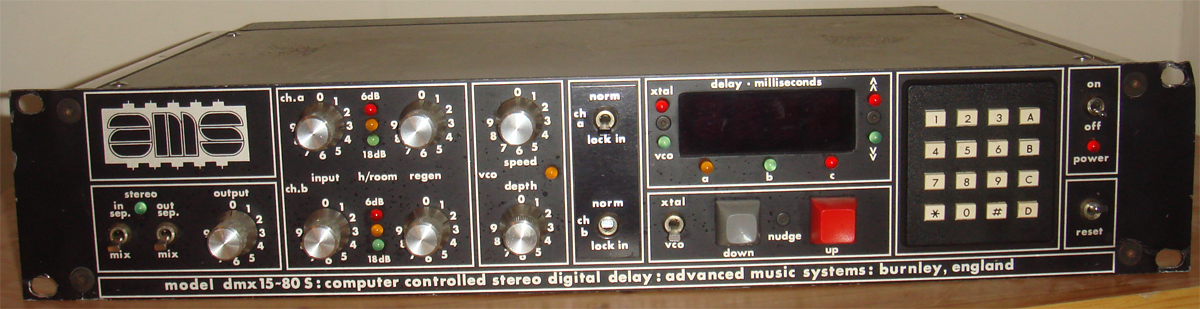
The really early AMS delays, known as the DMX 15-80 were mono in, stereo out. The units had gray sides, black top and bottom. Most had small amounts of memory and few survive. The DMX 15-80S was the stereo version, also with the gray sides, black top and bottom. Find great deals on eBay for ams dmx and ams rmx. Shop with confidence. AMS began producing their DMX delay and RMX reverbs in 1979, and continued manufacturing until about 1985. These two products were a huge hit in the pro audio industry, and were used on thousands on huge hit records. AMS RMX 16 reverb and DMX 15 80S delay in superb condition 15-80s rmx16. Dbx vintage OverEasy compressor limiter w/ original manual. Dahlhouse Studios. For sale is a great sounding late production run, great condition AMS DMX 15-80S stereo delay and effects unit, serial number 4178. This is a later version 15-80S unit, and is fitted with all the 15-80S updates.
16 Artists Use This
- The Edge
Music Radar interviews Edge's guitar tech Dallas Schoo in [this article](http://www.musicradar.com/us/news/guitars/u2-exclusive-the-edges-stage-setup-revealed-223342), and details his touring rig for 2009's '360° Tour.' It lists the 15/80S (also known as the SDMX) among his effects.
more - Steve Vai
An AMS DMX 15-80S Digital Delay is used by Steve Vai in his studio rig.
more - Guy Gerber
[Gerber plays a track and triggers an effect on the AMS DMX 15-80S digital delay unit] Did you see what it does? How cool is that? Wow. This fucking machine.
more - Damon Albarn
According to this article, Damon uses this in his recording studio.
more - Brian Eno
In [this article](https://valhalladsp.wordpress.com/tag/1580/), on the making of the Brian Eno sound, it read, 'Kevin Killen, answering a question about the signal flow on the U2 song “4th of July” on Gearslutz, described the signal path as follows: 'The delay and modulation was derived from the AMS 1580. On its fader return, some hi frequencies were rolled off, then it was fed into a 224 Hall setting, probably 5 seconds but with a rolloff in the top and bottom. This return may have been equalised also. We may have added a second delay but then the delays have to be timed to the track as the net effect is blurring the chord progression… Our last tweak would be to play with the sends on all of the returns to the point that its almost recirculating out of control, which in turn is creating a layer upon layer effect.'
more - cEvin Key
Two equipment racks in cEvin's old studio, Vancouver, 1997.
more - Mick Jagger
On the website, a post by Keith Clark on 07/17 at 11:28 AM states that Mick Jagger used AMS DMX 15-80S Digital Delay on a small studio called 'Bamboo Room Studio'.
more - George Michael
Used for Michael's vocals on 'Faith', as mentioned by sound engineer Chris Porter in this March 2013 *Sound on Sound* interview. > 'I only used a few effects for George's vocals. The Lexicon 224 produced those extended high-frequency pings that you can hear on the reverb-y vocals, and there was also the AMS RMX16 reverb and DMX 1580 delay line. The real characteristic vocal sound right the way through 'Faith' and beyond was an AMS 30-millisecond delay panned slightly left of centre, a 45-millisecond delay slightly right of centre; sometimes with pitch variation on each side, but generally not.
more - Peter Gabriel
In [this 1982 documentary on the making of Gabriel's fourth album](https://youtu.be/scmYG1Pv1_Q?t=10m50s), we see a shot of several pieces of gear set up in his then-home studio. At the 10:50 mark, there's a clear shot of the 15-80S delay unit.
more - Prince
time stamped video @ 4:22min mark you can see the rack at Princes Paisley Park. You can see the AMS stuffs closest to the camera.
more - Justin Meldal-Johnsen
In his studio, 2017
more - Daniel Lanois
In [this article](https://valhalladsp.wordpress.com/tag/1580/), about how Brian Eno and Daniel Lanois got their shimmer sound, it says, 'The AMS DMX 15-80s was a digital delay / sampler / pitch shifter that was in common use in Britain in the early 1980’s. Eno and Lanois have both sung the praises of this unit, and Wendy Carlos has said that the AMS unit had 'perhaps the least audible artifacts to pitch shifting available at that time.'
more - Martin Hannett
' On Joy Division' Unknown Pleasures I used several of my AMS 15-80S delays and my Marshall Time Modulators to create a room with walls that moved in and out'
more - Gary Numan
'The new AMS units will still be there - the DMX 15-80S has a 1.6 second delay which is quite enough, and if we want to fly in longer samples like hook lines or multiple backing vocals, we do it from quarter-inch tape. Because the studio isn't being used commercially I don't feel we need 35 second digital delays and I have to be a bit frugal on the financial side. The AMS RMX16 reverb and the Lexicon will stay, although we don't really need all the compressors and noise gates we have. There's a Scamp rack, some Drawmers, Kepex gates, a Universal Audio Limiter and a few other things - I think the Drawmers are my favourites.'
more - Julian Swales
The XTDP website features [a brief interview/quote from Julian](http://extendplay.blogspot.com/2013/04/kitchens-of-distinction.html) wherein he reveals some of the gear used during KoD's heyday. Among his rack units, he lists a 15-80S.
more - Martin Rushent
It was while working on the Human League's 'Fascination' that Martin Rushent invented one of the most popular studio tricks of the '80s: using the 'loop triggering' facility on the AMS DMX1580 digital delay as a primitive sampler. 'I used it for the bass, snare and bass riff,' he says. 'I knew AMS reasonably well by the time they brought out this very high-quality digital delay line, so I asked if they could adapt it so that it wouldn't erase its sample. I'd been working with the Linn Drum and realised that it was just a memory of drum sounds, but I wanted to make my own sounds. So they put in four seconds of delay for me. All you had to do was feed in the signal and it would start sampling the moment it saw a rise in voltage. Then you could edit it a bit. After that you'd set it to Fire mode and trigger it via a click fed into the audio input, so I used the Micro Composer to send it a pulse. AMS asked me to show them what I wanted it for so I did a demo by feeding in a bass drum sound and triggering it via the Roland. After that, they made it standard on their products, sold it to the Japanese, and I made fuck-all out of it!'
more
’s a really superb AMS unit from Studio Electronics. In our 5 years of servicing and selling AMS, this is probably the best looking unit we have ever seen. - it is truly in outstanding condition and has been fully refurbished. This is a rarely seen S-DMX version - the last and best DMX model that AMS ever built. It sounds perfect and works beautifully. The serial number 5393, one of the highest serial numbers we’ve ever seen. This was a very late model unit, probably manufactured in about 1984. This unit has dual delay, dual pitch change, dual lock in, flanging, VCO vibrato, automatic double tracking, Chorus Controller MIDI ready DB25 remote connector. The electronics have been fully serviced in our shop.
Ams Dmx 15-80s Manual Download
The memory, precisely controlled from the front panel, has 13 seconds on the left and 6.4 seconds on the right. This is a large amount of memory, rarely seen in an AMS delay. It has one-octave pitch shifters on both channels and the lock in function, with a deglitch card (some earlier DMX’s do not have this). The main chassis includes the later, higher current power supply and all the electrolytic capacitors in the power supplies have been replaced. The unit runs on 110, 220, or 240 volts, 50/60 Hz. All settings are stored in battery backup RAM; the unit has a fresh battery. All the internal ribbon cables have been replaced with new ones. The power transformer looks like it’s brand new. The unit is extremely clean and in excellent cosmetic and mechanical condition. The front panel looks totally perfect and new. The only visible flaws are some light scratches on the top cover.
